Thursday, November 8, 2012

Jardin de Berchigranges, France

I can almost not believe it myself – it’s been over 6 months since my last blog! I thought I was a little bit behind, but I didn’t realize the situation was this bad! And it’s not only my own blog I’ve neglected, but even the blogs I follow. So I spent the last few weeks reading up on my little blogging universe, and marveling at the developments in many people’s gardens over the past season. And catching up on all the news, such as the recent collision of illustrious gardeners and bloggers at Federal Twist, the incredible frequency of posts over at opensesame, and the change in continents for Intercontinental Gardener... But now that I’ve caught up, it’s time for a new post.

Looking back at my last blog, it seems that I left off with my two favourite gardens in France. As luck would have it, I made a repeat visit to the second one this August, so it’s fresh in my mind. The garden is Berchigranges, in the Vosges region of north-eastern France. I came to it through Noel Kingsbury, who described it as possibly "the most beautiful garden ever" on his blog.

The tour guides stand ready at the gates to Berchigranges! 

Berchigranges is a private garden, a labour of love created and maintained by husband and wife team Thierry and Monique Dronet. As soon as you step through the gate, it’s obvious that this is a very personal garden that somebody cares about, a lot. And it’s a garden that is happy being a garden. It’s not trying to make the latest design statement, or to impress visitors with anything particularly grand or novel. It is simply and unashamedly trying to create something pretty and charming. It uses flowers, lots and lots of them, and surrounds them with manicured lawns, pretty gazebos and water features. It’s not old fashioned or gaudy, it simply finds joy in growing beautiful things and combining them in beautiful ways.

View across the garden in early June. 

The garden is nestled on the side of a hill in the gently rolling countryside of the Vosges region, a popular tourist area characterized by its majestic deciduous forested hills. The garden covers almost 4 acres, and was built on the site of an old quarry. Over 25 years of work have gone into shaping the land into many levels, clearing and redistributing rocks, and constructing elaborate waterways. The whole garden slopes down from the main entrance, and offers open views of the majestic landscape beyond.


There are many distinct areas to this garden, each taking full advantage of the lay of the land. As you walk in the gate, the first area centers around a long pond, its water dark and still. A bridge covered in grass and using short boxwood hedging as its railing is the focal point. I honestly couldn’t take my eyes off this bridge – it seemed like such a simple idea, and yet it was so powerful and managed to capture the atmosphere and elegance of the place. Jardin de Berchigranges really does focal points brilliantly. Gardeners love to place various ‘things’ in the landscape to catch the eye, and books love to tell us that we should. But at Berchigranges, this was taken to the level of art.


Going on from the pond, the flower borders begin. Yes, they are irregularly shaped, with rounded edges and random curves. The owners have said that they developed the garden organically, without a master plan, and perhaps this is where it shows. But are the contents ever gorgeous! There are over 4000 plant species in this garden, and they spill out from every possible corner. While the style is abundant and loose, with lots of mixing and self-sowing evident, the gardener still appears to be very much in charge. Each composition is deliberate, and the wonderful colour and texture combinations are testament to a very sensitive eye and a lot of patience.

Delighting the senses in early June. 

My two visits to this garden were at very different times of the year: at the very beginning of June and at the end of August. But I was amazed to note that at both times, the garden seemed to be covered in blooms. There are so many plants, and everything is so carefully tended that it manages to peak throughout the year. It reminded me of Christopher Lloyd’s approach at Great Dixter, where he advocated intense planting and management to achieve a non-stop show in his long border. But achieving this on the scale of a full garden with a limited labour force is truly extraordinary. It takes unbelievable planning and a deep knowledge of plants, how they grow and how they can share the same space. Here are a few pictures of the plant combinations I saw in June and in August at Berchigranges, to give you an idea.

The same flower border at the beginning of June (top) and end of August (bottom), maintaining same colour scheme. 

Borders overflowing with growth and colour both in June (top) and August (bottom). 

The formal garden putting on growth through the summer. 

The bog garden was equally lush in August (bottom) as in June. 

As you walk around the grounds, the garden does fall into one little trap, which is trying to include a bit of everything. There is a a formal walled garden, a maze, an informal meadow, a rock garden, a gravel garden, pond, streams… you get the idea. As a plant lover, it's perfectly understandable that one would want to grow a bit of everything. And as a visitor, it did not upset me at all, as each part was an opportunity to showcase new and delightful things.


The last space of the garden is a graveled sitting area, decorated with charming wrought iron chairs and tables. I found it difficult to take a picture here without people – it was the end of the garden, and many visitors lingered here even if there were no cookies or tea. I guess none of us wanted to leave this little piece of paradise.

Monday, April 2, 2012

Les Jardins du Grand Courtoiseau, France

There are two gardens from my visits to France that I haven’t written about yet. I think I’ve hesitated because they were actually my two favourites, so I wanted to write something clever and insightful to do them justice. But since that’s unlikely to happen no matter how long I think about them, I might as well just take the plunge now.


Les Jardins du Grand Courtoiseau are the last gardens I visited during my trip to the Loire Valley, which is already a few years ago now. I showed up around lunch time and the garden looked deserted. According to my information, it should have been open, but the sign on the door disagreed. Opening time was only 2pm, by which hour I was supposed to be racing back to Belgium to return the rental car. Luckily, the gate was open. Well, maybe not so much open as not properly closed - there was sufficient space to (just) squeeze through the two large wooden gates (the opening is clearly visible in the picture above - anyone could have been confused). So... I trespassed into a private garden. In my defense, I assumed nobody actually lived there, and that I would run into a gardener or caretaker and explain the situation (you must let me in because I love gardens and this is the only time I can visit this one!). That is indeed what happened, and he very generously agreed after only a little bit of coaxing. It wasn’t until I got to the back of the gardens that I realized a very real family lives here, and that I was actually intruding on their very private outdoor lunch. But they too were extremely generous, and invited us to feel completely at home in the garden. I am therefore very grateful to the owners of this beautiful garden for allowing me to visit it in its natural state – with no hordes of visitors, just sunshine, bird song and a family enjoying their little piece of Eden.


On to the actual garden then. This is not a garden of groundbreaking design or cutting edge plantings. It is full of old fashioned white roses, evergreen hedges and neatly trimmed lawn. And yet, it made a powerful impression on me. I think the first reason is that it just fits so perfectly with the house and the countryside setting. Everything about this property exudes the same easy, effortless French charm and elegance. The second reason is that although the garden uses classical elements, it combines them in original and creative ways. There is clearly a very careful eye for plant combinations and colour, and a knack for creating perfect little vignettes.


It all starts with the house, a beautiful French villa in earthy tones of yellow stucco and brick, punctuated by stately, white French windows. The house is square, with a gravel courtyard in the middle. It sits more or less in the middle of the property, with gardens surrounding it on all sides. At the front of the house, formal gardens frame the way from the driveway to the entrance. In the back, the view from the eating patio is over a large simple lawn, with flower borders on both sides and mature trees in the back.


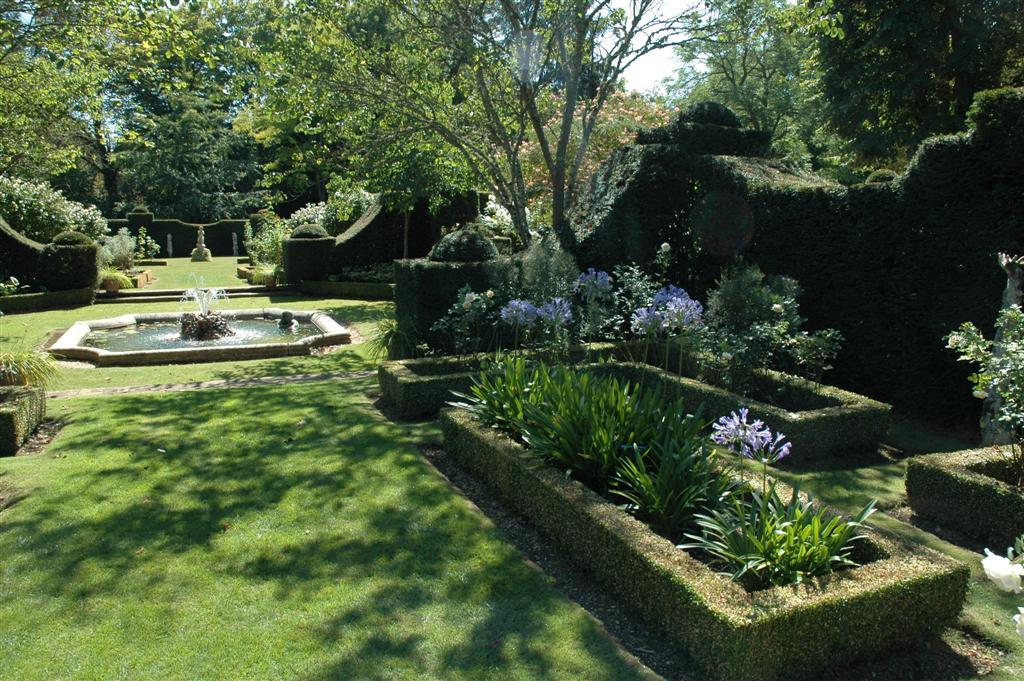
The more intensively gardened areas run parallel to the two sides of the house. The first side garden is rather formal and classical. It is divided into sections, or garden ‘rooms’, by wide yew hedges. Creative pruning of the hedge tops adds an interesting element to what could otherwise be a pretty plain garden. Inside the rooms, white, pale yellow and blue blooms predominate, nicely picking up the colour theme from the house. A simple square pool acts as the center piece in the middle garden room, while understated stone steps create level changes that beautifully define the space. Everything is quite relaxed, but also well taken care of – the presence of a dedicated gardener is clearly evident.


The garden on the other side of the house is a shady woodland garden, sheltered by the canopy of tall mature trees. Here the look is much less informal, with simple winding paths and loose plantings of the usual woodland suspects, including hostas and rhodos.


As already mentioned, the best parts of the garden were the little hidden vignettes, mostly found in narrow spaces adjacent to the house. One such example was a narrow walkway on the shady side of the house, where a row of tall bamboo provided a backdrop for a simple underplanting of variegated hostas and hydrangeas. Simple and stunning.


Perfect little details could be found all over the gardens, sometimes in the most unexpected and out of the way corners.


At the end of the visit there is one last nice surprise, a little walled garden area for the pool. What a dream to go for a dip here and lounge in the sun after a hard day of gardening.

Monday, December 19, 2011

Landschaftspark Duisburg-Nord, Germany

The Landschaftspark in the north of Duisburg near Dusseldorf is a public park built on the site of a defunct steel mill. It seems that a lot of these projects are popping up across Germany, rehabilitating old factories into modern, multifunctional parks. As with other German landscape projects, very little information is available about this one in the English media, and I probably would have never heard of it if it wasn’t mentioned in a little article by Tim Richardson, which was also posted on thinkinGardens. In the piece, Richardson describes the park as “an absolutely extraordinary experience”, achieved “with the lightest of touches.”


The steel factory was abandoned in 1985, leaving behind an assortment of monstrous structures and polluted soil. The transformation into a public park was initiated in 1991, and was carried out by landscape architect Peter Latz, of the firm Latz + Partner. Unlike other proposals that were made for the site, his aimed to keep most of the existing buildings, and use them to illustrate and understand the industrial past rather than cover it up. As a result, everything has been left in place: the gigantic factory buildings, concrete storage bunkers of mammoth proportions, pools and canals, and the old railway. But everything has been put to new and often unexpected usage.

The factory buildings themselves provide the dominant theme for the park. They are in a perfect state of romantic dilapidation – rusted, cracking at the joints, and with signs of nature’s reclamation sprouting up everywhere. Access is allowed into several buildings through narrow and steep stairways that lead to a labyrinth of dark walkways. A little unsettling to a North American used to overly tight safety regulations. The edgy industrial feel of these buildings seemed to appeal to two groups in particular: teenage rock bands looking for a backdrop for their bad-boy cover shots, and well-equipped amateur photographers. You could find plenty of both hidden in the most unexpected dark recesses of the buildings.


The great concrete bunkers and various concrete storage structures that surround the factory buildings were also left in place. They are now put to creative use either as playgrounds featuring gigantic sand boxes and twisting slides, or as climbing walls. As a climber myself, the latter was really nice to see. And very tempting since the climbing rope happened to be in the car!


All this is well enough, but what about the green stuff that usually goes in parks? I think Richardson already described the approach perfectly when he said the “lightest of touches” was used. Most of the greenery seems to be whatever happens to grow there - it's hard to tell what was planted and what was already found growing at the abandoned site. There are a few exceptions, such a simple geometric planting of trees at the entrance to the park, and some pruned hedges here and there to punctuate the chaos. The soil was quite polluted, but Latz chose not to replace it. Instead, the very fancy-sounding approach of “phytomediation” was taken, meaning that the soil was left in place and plants are now used to do the rehabilitation work. Perhaps what seemed like a mess of random vegetation is actually a carefully chosen mix of soil detoxifying plants?


The only more ‘gardened’ area, if one can call it that, is across from the factory buildings on the other side of the canal. Here, there are a series of gigantic concrete bunkers, which look like boxes with no tops. There is an elevated walkway which allows visitors to look into the boxes from above. Given the viewpoint, the planting patterns are kept simple and obvious. Several boxes are planted with straight rows of identical plants, which I thought worked quite well. In one box, the only one you can actually walk into, tightly clipped hedges were used to create a strong geometric pattern which was both striking from above and effective below. Although the hedge pattern is not classical, the garden contained mostly traditional plants, such as roses and hydrangeas.


The Duisburg Landschaftspark is certainly a very interesting experiment, and a park unlike any I have seen before. But personally, the feeling I got walking through it was one of uneasiness, of being on edge. There is no sugar coating the industrial history here, no softening of the landscape with pretty plantings. Certainly many elements are original and may provide important inspiration for the future. But to me, it felt a bit like a very modern house – nice to see and visit, but just not comfortable to live in.

Sunday, November 13, 2011

Karl Foerster Garden, Germany

The name Karl Foerster is enough to inspire awe in many gardeners, particularly those of us interested in perennial plantings and naturalistic design. Foerster first made a name for himself as a plantsman based on his innovative plant selections at his nursery in eastern Germany. Starting all the way back in 1903, Foerster looked at plants in a different way than most people. He wanted perennials that were sturdy and looked good massed, and was drawn to plants with elegant but strong flower spikes. His earliest work was with delphinium (a rather un-slender flower spike), but grasses soon became a favourite. Today, few gardens are without Calamagrostis x acutiflora 'Karl Foerster'.

The grass aisles at the Foerster nursery - uhhhhh.

In addition to plant selection, Foerster also dabbled in garden design. In the garden adjacent to his nursery, he experimented with a naturalistic planting style by combining grasses and massed perennials to achieve an overall meadow effect - an approach starting to sound almost too familiar today. His work is credited with greatly influencing the New German style of planting and the naturalistic planting movements that have since followed.


Clearly there is a lot of history at the Karl Foerster garden, so my expectations ran high. But as usually happens in these cases, the image built up in my mind did not exactly match the reality on the ground. The first surprise was the size. This is a small private garden created around the front and back of the family house. So expect a short visit to a tiny garden!


The second surprise was the content of the garden itself. I, unfairly, expected a very modern garden, one that would have been eons ahead of its time in the early 1900’s. But today the garden doesn’t look revolutionary to us, it just looks like something we’ve seen before. The plants are now familiar, and the style is hardly radical. It’s difficult to imagine how people viewed this garden during Foerster’s time, when annual bedding schemes and roses were the norm. It’s also hard to know how much the garden itself has changed over the years, as its maintenance has passed through several generations (currently Foerster's granddaughter).


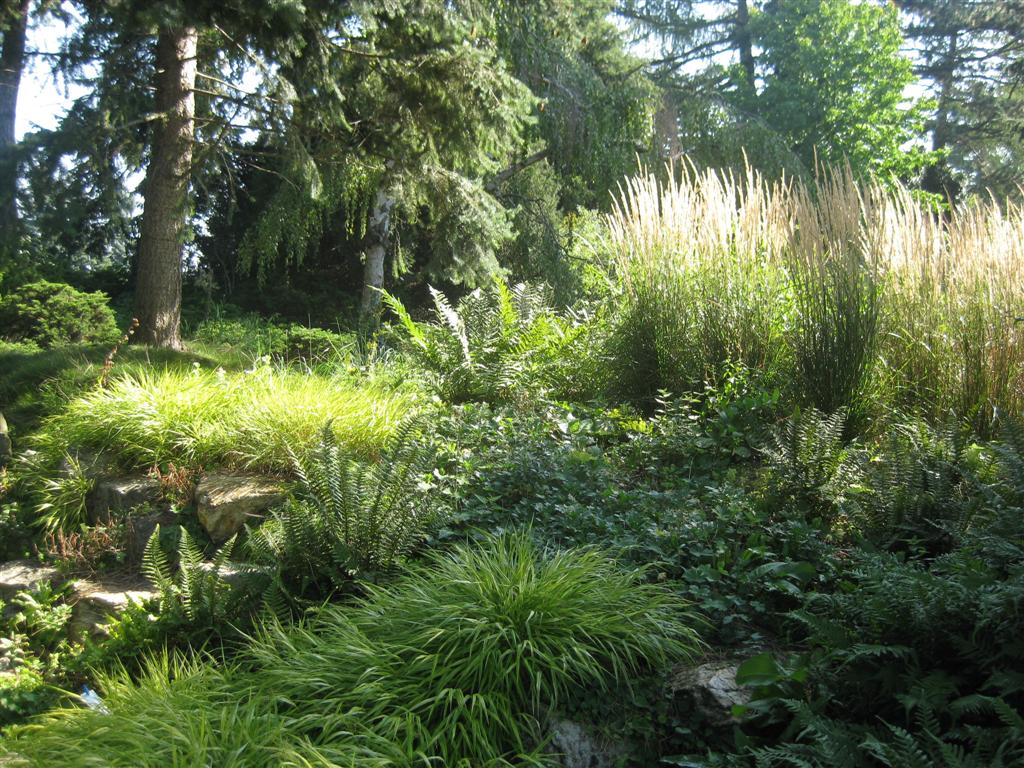
Viewed with today’s eyes, this looks like a richly planted garden with an interesting mix of perennials, grasses and large trees, built around a fairly classical framework. In the back of the house is the rock garden, with mounded rocky beds and winding paths. There were many interesting examples of grasses here, such as the soft Carex alba planted between rocks. This garden is now quite shaded by large trees, conditions which seem less than ideal for some of the grasses.


Carex alba and bergenia softening rocks.

The front garden is definitely the highlight of the visit. It’s a symmetrical garden built around a rectangular, sunken pond. It reminded me a bit of the water garden at Castillon-Plantbessin, one of my absolute favourite places. This one is almost just as good, which means I’m now officially in love with sunken pond gardens. The plants were tightly packed, and included a lot of the perennials and grasses we are now used to seeing. Overall, it seemed like a nicely designed perennial garden, but I didn’t get the sense that the style was ‘naturalistic’. Many perennials fit the naturalistic palette, but there were relatively few grasses and massed plantings. Regardless, it’s a little jewel of a garden which makes for an inspiring visit if you don’t bring along too many preconceived ideas.