Showing posts with label hedges. Show all posts

Saturday, November 17, 2012

Wim van Wassenhove’s Garden, Belgium

After 4 years of living in Belgium, I realized, to my great dismay, that Belgian gardens have been greatly under-represented on this blog. Isn’t it so often true that we ignore what we have at home and look away for inspiration? In my defense, I think I can explain why this happened.

First, Belgium is surrounded by some of the finest gardening nations in the world – the Netherlands, Germany, France and the UK. The temptation to go beyond the borders is therefore somewhat understandable. But given its illustrious neighbors, one might also naively think that Belgium is the place where these influences come together to create a gardening epicenter. Alas, it is not so. As I discovered soon after moving, the most important criteria in shaping the Belgian landscape are neatness and practicality, resulting in some rather sterile gardens.  What the Belgians seem to love more than anything else are immaculate lawns, tight hedges, and all manner of pruned, trellised, pleached and espaliered plants. I believe nothing delights the average Belgian more than running outside the instant a new leaf grows beyond the planned geometry of the garden and promptly snipping it off.

Although this may sound like mocking, I have gained a lot of respect for the Belgian approach to landscaping. Training plants into geometrical shapes can be a very valuable tool in the landscape, one that I think is under-used in North America. In Belgium, the technique has been greatly refined over the centuries, and is now perhaps best embodied by the innovative work of Jacques Wirtz. Unfortunately, most of his work is in private gardens and estates, and therefore not accessible to the lowly blogger.

A Wirtz hedge in his private garden. More on his work can be found in this nice article in the NY Times as well as a post on Grounded Design, where I found this picture. 

Instead of Wirtz’s iconic work, I will talk about some small, private, and more plant intensive gardens that I visited as part of the Belgian national open gardens scheme. The first was Wim van Wassenhove’s garden. I actually went to this one by mistake, but after spending 2 hours getting there by bus, train and foot, there was no turning back (and I certainly don’t regret it). Van Wassenhove is a landscape designer and nurseryman practicing in the western part of Flanders. Immediately upon entering his garden in the tiny village of Zedelgem, it’s clear that he also has a healthy level of that famous Belgian hedge gene. Neatly trimmed boxwood greets the visitor at the front door, and a tall yew hedge carefully encloses the entire front garden.

The path and hedges leading up to the front door, and the gate to the front garden.  

At the back of the house, hedges are again in the spotlight. The backyard is defined by strong horizontal and vertical lines. The horizontal lines build up in layers, starting with the brick terrace, then the long rectangular pond that parallels the terrace, followed by the dividing line between the lawn and field, and finally the horizon line. As you go away from the house, the lines get increasingly less defined, amplifying the sense of depth. At right angles with these are the strong verticals, represented by neatly trimmed hedges. The hedges are quite narrow, and run in parallel rows that lead the eye out to the larger landscape. Van Wassenhove is, by the way, the designer who told me he uses laser guides to install and trim hedges in clients’ gardens to ensure perfect straight lines.

Moving from the back of the house to the end of the garden reveals the details of the horizontal and vertical structures. The long rectangular pool is a more formal version of the small canal dividing the property from the fields at the back of the garden.  

The central axis is very powerful, but a lot is happening on the sides as well. Neatly trimmed boxwood rectangles are scattered throughout and combined with level changes to create an interesting play of geometrical shapes. The picture is softened by looser plants inserted in between, creating a nice overall balance.

Trimmed boxwood, loose plantings and creatively used sculptures and accents work together to create a balanced and interesting picture.  

In addition to this garden, which is quite ‘designed’ and I think pretty representative of the Belgian style, there is a second flower garden. This secret garden is completely out of the way and separate from the main garden, concealed behind the greenhouses and potted beds used for the nursery. This is very typically Belgian – to hide the loose and flowery bit somewhere in the back, and treat it almost as a play area that shouldn’t interfere with the real garden.


This flower garden looks almost like a nursery itself. It’s set up as several parallel paths with borders in between (instead of potted plants). There is a lot of plant material here, and it is well grown. Obviously van Wassenhove loves his plants, even if he chooses to only use them sparingly in the rest of the garden. I visited in the middle of June, which wasn’t yet the peak for this garden. There were a lot of ‘new perennials’ in the mix (no doubt the Dutch influence next door), but surprisingly few grasses. It seemed like more of a traditional English border, but using modern plants.

Plants such as Knautia macedonica, cranesbill geranium and some roses were the highlights in early June. The purple groundcover in the bottom picture is Phuopsis stylosa purpurea, a plant new to me.  

The last area of the garden was the most naturalized. It followed a small canal, of the kind traditionally used to divide fields in the lowlands. In this narrow, boggy area, named varieties of plants mingled freely with gnarly, pollarded willows and field grasses. It seems that the Belgians can let loose after all, even if only in the furthest recesses of the garden.

Monday, April 2, 2012

Les Jardins du Grand Courtoiseau, France

There are two gardens from my visits to France that I haven’t written about yet. I think I’ve hesitated because they were actually my two favourites, so I wanted to write something clever and insightful to do them justice. But since that’s unlikely to happen no matter how long I think about them, I might as well just take the plunge now.


Les Jardins du Grand Courtoiseau are the last gardens I visited during my trip to the Loire Valley, which is already a few years ago now. I showed up around lunch time and the garden looked deserted. According to my information, it should have been open, but the sign on the door disagreed. Opening time was only 2pm, by which hour I was supposed to be racing back to Belgium to return the rental car. Luckily, the gate was open. Well, maybe not so much open as not properly closed - there was sufficient space to (just) squeeze through the two large wooden gates (the opening is clearly visible in the picture above - anyone could have been confused). So... I trespassed into a private garden. In my defense, I assumed nobody actually lived there, and that I would run into a gardener or caretaker and explain the situation (you must let me in because I love gardens and this is the only time I can visit this one!). That is indeed what happened, and he very generously agreed after only a little bit of coaxing. It wasn’t until I got to the back of the gardens that I realized a very real family lives here, and that I was actually intruding on their very private outdoor lunch. But they too were extremely generous, and invited us to feel completely at home in the garden. I am therefore very grateful to the owners of this beautiful garden for allowing me to visit it in its natural state – with no hordes of visitors, just sunshine, bird song and a family enjoying their little piece of Eden.


On to the actual garden then. This is not a garden of groundbreaking design or cutting edge plantings. It is full of old fashioned white roses, evergreen hedges and neatly trimmed lawn. And yet, it made a powerful impression on me. I think the first reason is that it just fits so perfectly with the house and the countryside setting. Everything about this property exudes the same easy, effortless French charm and elegance. The second reason is that although the garden uses classical elements, it combines them in original and creative ways. There is clearly a very careful eye for plant combinations and colour, and a knack for creating perfect little vignettes.


It all starts with the house, a beautiful French villa in earthy tones of yellow stucco and brick, punctuated by stately, white French windows. The house is square, with a gravel courtyard in the middle. It sits more or less in the middle of the property, with gardens surrounding it on all sides. At the front of the house, formal gardens frame the way from the driveway to the entrance. In the back, the view from the eating patio is over a large simple lawn, with flower borders on both sides and mature trees in the back.


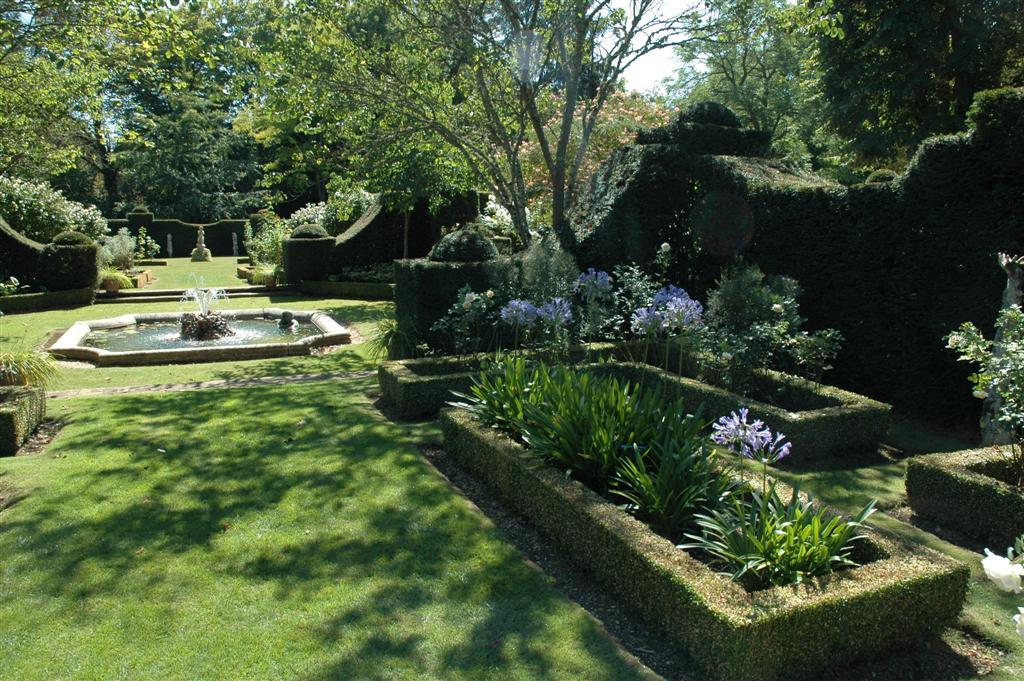
The more intensively gardened areas run parallel to the two sides of the house. The first side garden is rather formal and classical. It is divided into sections, or garden ‘rooms’, by wide yew hedges. Creative pruning of the hedge tops adds an interesting element to what could otherwise be a pretty plain garden. Inside the rooms, white, pale yellow and blue blooms predominate, nicely picking up the colour theme from the house. A simple square pool acts as the center piece in the middle garden room, while understated stone steps create level changes that beautifully define the space. Everything is quite relaxed, but also well taken care of – the presence of a dedicated gardener is clearly evident.


The garden on the other side of the house is a shady woodland garden, sheltered by the canopy of tall mature trees. Here the look is much less informal, with simple winding paths and loose plantings of the usual woodland suspects, including hostas and rhodos.


As already mentioned, the best parts of the garden were the little hidden vignettes, mostly found in narrow spaces adjacent to the house. One such example was a narrow walkway on the shady side of the house, where a row of tall bamboo provided a backdrop for a simple underplanting of variegated hostas and hydrangeas. Simple and stunning.


Perfect little details could be found all over the gardens, sometimes in the most unexpected and out of the way corners.


At the end of the visit there is one last nice surprise, a little walled garden area for the pool. What a dream to go for a dip here and lounge in the sun after a hard day of gardening.

Monday, May 16, 2011

Les jardins de Séricourt, France

Les jardins de Séricourt were the last gardens we visited on our trip to Normandy last year. I think we may have been suffering from garden burn-out by the time we got to this one, which may explain why I don't feel the urge to write a long and tedious ramble about it. It is in no way a criticism of the gardens, which were quite beautiful and certainly worthwhile. So instead I’ll just leave you with a photo journey through them.

Very briefly, the gardens were designed by landscape architects Yves and Guillaume Gosse de Gorre, who used a series of rooms to divide the large grounds. The rooms are quite intimate in the center on the garden, while on the perimeter they open up and merge into the surrounding landscape of forest and meadow. Several of the central gardens were designed around the theme of war, with some interesting representations of it. A characteristic feature at Séricourt is the exquisite topiary and hedge work, which is used throughout the gardens to create its most memorable images.

Rambling roses mark the entrance to the gardens.

Interesting clipped shapes are dotted throughout, surprising the visitor in unexpected places.

The first of the war-themed gardens: a field of yew soldiers on guard.

In Flanders fields ...

Bomb craters eerily similar to the real ones we had just seen on the beaches of Normandy.

Figures scattered in the field - soldiers, villagers?

An outer garden merges with the field and forest beyond.

Séricourt's trademark topiary and clipped hedges - the whole garden is an inspiration on how to use green sculptures.