Showing posts with label woodland garden. Show all posts

Monday, April 2, 2012

Les Jardins du Grand Courtoiseau, France

There are two gardens from my visits to France that I haven’t written about yet. I think I’ve hesitated because they were actually my two favourites, so I wanted to write something clever and insightful to do them justice. But since that’s unlikely to happen no matter how long I think about them, I might as well just take the plunge now.


Les Jardins du Grand Courtoiseau are the last gardens I visited during my trip to the Loire Valley, which is already a few years ago now. I showed up around lunch time and the garden looked deserted. According to my information, it should have been open, but the sign on the door disagreed. Opening time was only 2pm, by which hour I was supposed to be racing back to Belgium to return the rental car. Luckily, the gate was open. Well, maybe not so much open as not properly closed - there was sufficient space to (just) squeeze through the two large wooden gates (the opening is clearly visible in the picture above - anyone could have been confused). So... I trespassed into a private garden. In my defense, I assumed nobody actually lived there, and that I would run into a gardener or caretaker and explain the situation (you must let me in because I love gardens and this is the only time I can visit this one!). That is indeed what happened, and he very generously agreed after only a little bit of coaxing. It wasn’t until I got to the back of the gardens that I realized a very real family lives here, and that I was actually intruding on their very private outdoor lunch. But they too were extremely generous, and invited us to feel completely at home in the garden. I am therefore very grateful to the owners of this beautiful garden for allowing me to visit it in its natural state – with no hordes of visitors, just sunshine, bird song and a family enjoying their little piece of Eden.


On to the actual garden then. This is not a garden of groundbreaking design or cutting edge plantings. It is full of old fashioned white roses, evergreen hedges and neatly trimmed lawn. And yet, it made a powerful impression on me. I think the first reason is that it just fits so perfectly with the house and the countryside setting. Everything about this property exudes the same easy, effortless French charm and elegance. The second reason is that although the garden uses classical elements, it combines them in original and creative ways. There is clearly a very careful eye for plant combinations and colour, and a knack for creating perfect little vignettes.


It all starts with the house, a beautiful French villa in earthy tones of yellow stucco and brick, punctuated by stately, white French windows. The house is square, with a gravel courtyard in the middle. It sits more or less in the middle of the property, with gardens surrounding it on all sides. At the front of the house, formal gardens frame the way from the driveway to the entrance. In the back, the view from the eating patio is over a large simple lawn, with flower borders on both sides and mature trees in the back.


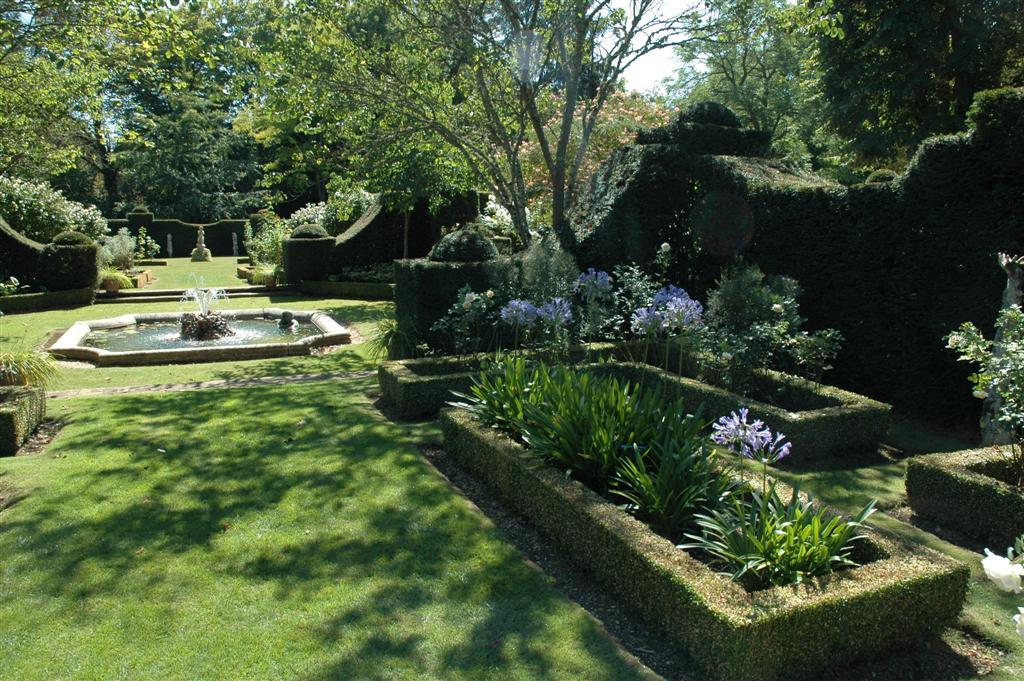
The more intensively gardened areas run parallel to the two sides of the house. The first side garden is rather formal and classical. It is divided into sections, or garden ‘rooms’, by wide yew hedges. Creative pruning of the hedge tops adds an interesting element to what could otherwise be a pretty plain garden. Inside the rooms, white, pale yellow and blue blooms predominate, nicely picking up the colour theme from the house. A simple square pool acts as the center piece in the middle garden room, while understated stone steps create level changes that beautifully define the space. Everything is quite relaxed, but also well taken care of – the presence of a dedicated gardener is clearly evident.




The garden on the other side of the house is a shady woodland garden, sheltered by the canopy of tall mature trees. Here the look is much less informal, with simple winding paths and loose plantings of the usual woodland suspects, including hostas and rhodos.


As already mentioned, the best parts of the garden were the little hidden vignettes, mostly found in narrow spaces adjacent to the house. One such example was a narrow walkway on the shady side of the house, where a row of tall bamboo provided a backdrop for a simple underplanting of variegated hostas and hydrangeas. Simple and stunning.


Perfect little details could be found all over the gardens, sometimes in the most unexpected and out of the way corners.


At the end of the visit there is one last nice surprise, a little walled garden area for the pool. What a dream to go for a dip here and lounge in the sun after a hard day of gardening.

Thursday, September 1, 2011

Hermannshof, Germany - Part III

I promise this is my last post on Hermannshof in Germany. This is definitely the most cyber space I have used for a single garden, but there was just too much to digest in one blog. This last post is about the woodland garden, the small pond, and a long perennial bed of more classical composition which borders the central lawn.

One of the goals of Hermannshof is to experiment with plant groupings inspired by different natural habitats, and that includes woodland. The park is fortunate to have many mature trees to provide a believable woodland backdrop, including massive specimens of dawn redwood, larch and tulip tree. The open, sunny gardens gradually transition into woodland with some smaller woodland edge trees, such as magnolias and dogwoods, before being plunged into the deep shade of giants.


The woodland sections are just as richly planted as the prairie gardens, and the fascination with North American natives continues. Various types of epimediums, ferns, sedges, hellebores and hardy geranium form a dense and complex tapestry on the woodland floor. One of the most striking plants I saw, and which I didn't know before, was Paeonia mlokozewitschii. It was an eye catcher in a sea of green – prominent blue seeds in bright red pods, strong leaf shape and even some leaf colour at the beginning of August. And that's just the after-show, since it flowers in the spring.

Paeonia mlokozewitschii

One aspect of the woodland garden at Hermannshof which I found distinctive was the great number of grasses used, particularly in the edge areas. I noted Luzula sylvatica or Greater Wood Rush looking good (not pictured). There were also some showier perennials in the edge areas, such as Lillium martagon and Lobelia cardinales.


The pond deserves only a very short mention, as it was placed in a rather awkward spot on the side of the great central lawn. It was bordered by lawn on one side, and wetland plants on the others. Although I didn't find it anything special, it was interesting to note that it was still a magnet for visitors, as water always seems to be.


The last section I got around to was the perennial border on the woodland side of the great lawn. This is not accessible from the woodland garden, so you have to decide to walk all the way back across the central lawn see it. Part of this border used huge specimens of Hakonechloa macra to set up a strong rhythm, very dramatic even from far away. Further down, the plantings were more reminiscent of a classical mixed perennial border, but with some nice colour combinations which I think the pictures show off best.


Well, that's it for Hermannshof. The romp through Germany continues next time with a garden which was, unfortunately, a bit of a disappointment... didn't think that was possible in Germany, did you?

Thursday, June 23, 2011

Peter Janke Garden, Germany

I have been very, very behind on my blog lately. A common complaint in the blogosphere, usually followed by a vow to do better, which never materializes. My impression is that making unrealistic blog resolutions is the beginning of the end of a blog. So I'm not going to make any promises, only try to keep plugging away at the many gardens still in my un-blogged stash.

I am now finally getting around to the Germany trip of last fall, one of my best garden visiting trips so far. The first garden we went to was Peter Janke's in Hilden (near Dusseldorf), which I learned about through James Golden's Federal Twist blog. Janke is a nurseryman, garden designer, and one of the leading figures in the exciting German landscape design scene.


His garden is a very large, rectangular piece of land, bordered by a very busy road on one side and an impressive mature forest on all others. The driveway bisects the property from the road, and leads to the central house and nursery. The driveway is the first impressive feature of the garden, with a very simple but striking use of Verbena bonarensis as edging along both sides (about 20m long stretch I would guess).


The right half of the front garden is occupied by a simple meadow with a circular pattern of mown grass in the middle, as well as a mown path bordered by fruit trees. At the time of our visit, the grass was uniformly tan in colour, with few other interlaced plants.


The left half of the front garden is taken up by the gravel garden, inspired by Beth Chatto's work in Essex. Peter Janke has studied with Chatto and credits her as a great influence on his work. This garden was absolutely spectacular at the time of our visit on September 4th. Everything seemed to sparkle in the autumn sun: delicate grass blades and seed heads, silver foliage, papery fall blooms and spiky dried flower heads.


At the back of the property lies the woodland garden, where the presence of the mature forest is keenly felt. This garden is cool and wet, in contrast to the open front areas. Simple mulch paths snake through it, along the edge of the forest. The garden is so lush you can hardly see outside of it. Many small and larger ponds are hidden between the foliage, and some were covered in a copper or rust coloured film. I'm not sure what the source of this is, but it made for an interesting contrast with the surrounding green.


Everywhere in the garden, there were little details that caught my eye, such as the interesting border edge below.


Or the wild abundant herb garden, with plants popping up through every crack in the paving, creating that beautiful contrast between geometrical and organic lines.


And the imaginatively pruned or placed trees throughout the property.


It was definitely a treat to be able to visit this garden. It combines a great mix of modern and classic, both in the design and the plants. It might have been even better if I spoke German as Peter Janke did a tour of the garden (we visited on a special open day). Would have loved to learn from what he had to say, although the garden was already a good teacher by itself.

Sunday, October 3, 2010

Wisley Garden, England


The RHS garden Wisley is supposed to be the jewel in the RHS’ crown. It’s certainly a fantastic garden, which has almost anything one might be interested in as a gardener. Unfortunately for me, Wisley came at the end of our spring trip to England and I have to admit that I was a little bit gardened out. I really didn’t think this would ever be possible, but apparently five large gardens and an even larger garden show are just about enough for one trip. And maybe, although it seems sacrilege to even suggest it, I also grew tired of the absolute perfection of each garden we visited. Forests and wild meadows never seem to lose their charms – could it be that English gardens, or any type of garden for that matter, are just too ‘landscaped’ for their own good? Or maybe I’m just reading way too much into this – seeing multiple castles or paintings can also wear you down, no matter how beautiful each is individually.

But I digress. Back to Wisley, which really is a very lovely garden. It’s the oldest garden owned by the RHS, which means the Society has had over 100 years to develop it into one of the top attractions in England. The well-known greenhouse is instantly recognizable, while the Wisley trial fields are the sacred ground where the “RHS Award of Merit” is determined. There is great history at Wisley, a true establishment of English gardening culture.


As the gardens are very large, I’ll just go through a few of my favourite sections. One of the latest notable additions to the garden is Piet Oudolf’s modern take on the English double border. His wide borders run from the aforementioned signature greenhouse up a large slope, to the upper part of the gardens. While in late May they clearly weren’t at their full glory, they were still nicely filled in. I did think that perhaps some more structure (which is often found in Oudolf’s work) would have made the composition stronger, but maybe late spring is not the best time to judge.


A completely different area was the alpine garden. Here, attention was focused on the individual plants, and late spring was a great time to visit. As one might expect, everything was grown to perfection - a real candy store for the alpine plant enthusiast.


As seems to be often the case, I also really enjoyed the woodland section. There were two woodland sections at Wisley, one a little more ‘gardened’ with smaller trees and a great concentration of lovely woodland floor plants, and another which was more forest-like, at the further end of the garden. The latter featured some amazing rare and old tree specimens, as well as an impressive collection of rhododendrons and azaleas, all in bloom. A beautiful garden to enjoy, even in the perennial English drizzle.