Showing posts with label Hermannshof. Show all posts

Thursday, September 1, 2011

Hermannshof, Germany - Part III

I promise this is my last post on Hermannshof in Germany. This is definitely the most cyber space I have used for a single garden, but there was just too much to digest in one blog. This last post is about the woodland garden, the small pond, and a long perennial bed of more classical composition which borders the central lawn.

One of the goals of Hermannshof is to experiment with plant groupings inspired by different natural habitats, and that includes woodland. The park is fortunate to have many mature trees to provide a believable woodland backdrop, including massive specimens of dawn redwood, larch and tulip tree. The open, sunny gardens gradually transition into woodland with some smaller woodland edge trees, such as magnolias and dogwoods, before being plunged into the deep shade of giants.


The woodland sections are just as richly planted as the prairie gardens, and the fascination with North American natives continues. Various types of epimediums, ferns, sedges, hellebores and hardy geranium form a dense and complex tapestry on the woodland floor. One of the most striking plants I saw, and which I didn't know before, was Paeonia mlokozewitschii. It was an eye catcher in a sea of green – prominent blue seeds in bright red pods, strong leaf shape and even some leaf colour at the beginning of August. And that's just the after-show, since it flowers in the spring.

Paeonia mlokozewitschii

One aspect of the woodland garden at Hermannshof which I found distinctive was the great number of grasses used, particularly in the edge areas. I noted Luzula sylvatica or Greater Wood Rush looking good (not pictured). There were also some showier perennials in the edge areas, such as Lillium martagon and Lobelia cardinales.


The pond deserves only a very short mention, as it was placed in a rather awkward spot on the side of the great central lawn. It was bordered by lawn on one side, and wetland plants on the others. Although I didn't find it anything special, it was interesting to note that it was still a magnet for visitors, as water always seems to be.


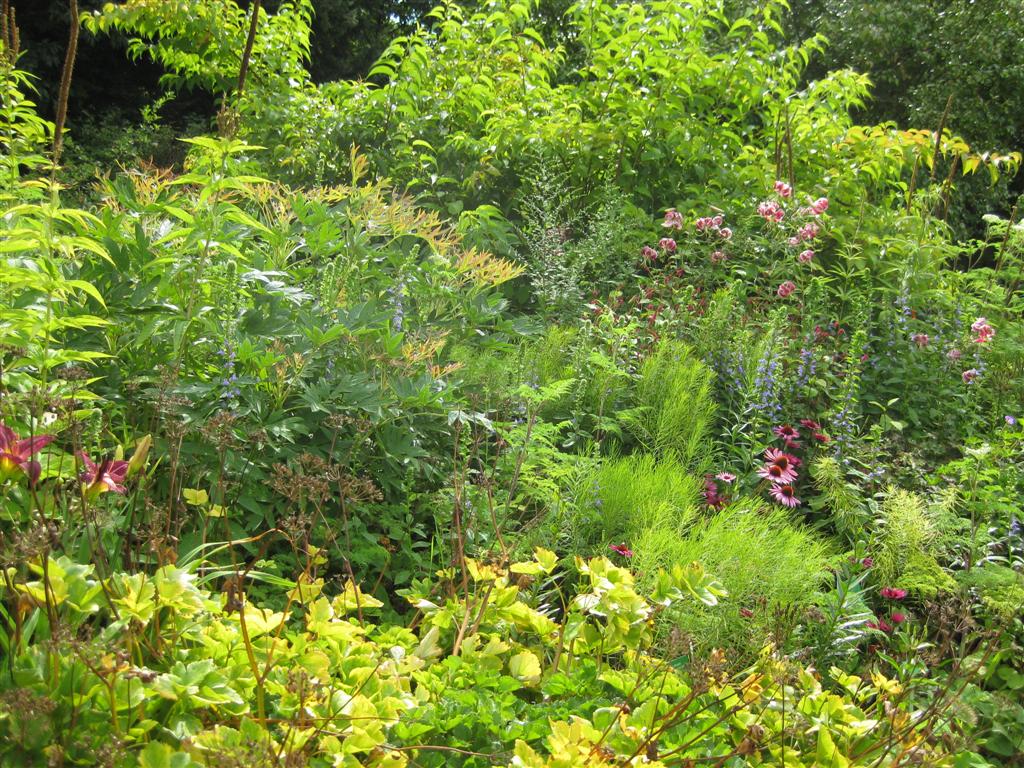
The last section I got around to was the perennial border on the woodland side of the great lawn. This is not accessible from the woodland garden, so you have to decide to walk all the way back across the central lawn see it. Part of this border used huge specimens of Hakonechloa macra to set up a strong rhythm, very dramatic even from far away. Further down, the plantings were more reminiscent of a classical mixed perennial border, but with some nice colour combinations which I think the pictures show off best.

Well, that's it for Hermannshof. The romp through Germany continues next time with a garden which was, unfortunately, a bit of a disappointment... didn't think that was possible in Germany, did you?

Thursday, August 11, 2011

Hermannshof, Germany - Part II

Hermannshof is a fantastic, public experimental garden hidden in the small town of Weinheim in south-west Germany. The aim of Hermannshof is to showcase “successful examples of new directions in planting design, especially in the naturalistic planting style”. There is too much interesting stuff happening in this garden for just one blog, so this is part two. Last time I tried to give a little tour of the North American perennial garden, which uses many of the very striking flowering perennials we've come to know and love through the New Perennial movement. Although the North American perennial garden is open and uses a mix of both perennials and grasses, it’s a perennial flower garden rather than a prairie inspired garden. The separate prairie inspired gardens are the topic of this post.


The prairie gardens are found at the entrance section to Hermannshof, and are based on the tall and mixed grass prairies of North America. But signs are quick to point out that the gardens are not meant as a re-creation of a prairie, but rather an artistic interpretation of the prairie idea, which seems to so captivate European gardeners.


I found it very interesting to contrast these gardens with the previous North American perennial sections. Grasses make up the bulk of the planting, with flowering plants mixed in but at a pretty low percentage. The colour is predominantly green in early August, though it would be very interesting to see it later in the year as grass seed heads and fall colours become more apparent.


The planting seemed extremely informal and relaxed, but I think that belies its complexity. Flowering perennials were mixed in with layers of grasses in intricate ways. In some instances, there were large colonies of certain flowers, such as Echinacea angustifolia below. In other cases, many different single plants could be found in a small area. I wonder how much of this is controlled and how much is self-seeded, and what they do for maintenance in this garden.


In early August, the height of the plants was already impressive. Walking down some paths, you felt completely swallowed by the vegetation. The best 'garden' experience in my mind.


Although the North American prairie garden did get top billing, there were also two sections devoted to its European cousin, the Mediterranean steppe. I particularly liked one of them, which was used as a lead-in to the woodland sections. Shorter grasses dominated the scenery, and I especially admired the fluffy, soft seedheads of the grass below. Anyone know what it might be? Autumn moor grass (Sesleria autumnalis) also looked great, with very clean, bright green foliage. It was the perfect partner to lime green Peucedanum verticellare, which I didn't know before but it was used to great effect throughout this area.


Autumn moor grass (Sesleria autumnalis) in the foreground and the umbellifer Peucedanum verticellare (or Angelica verticillaris)

The prairie and steppe sections at Hermanshof are some of the most complex and interesting gardens I have seen so far, and I think it’s especially impressive to find them in a public park. It’s quite bold to use so few flowering plants in a public garden in a very non-traditional design. But there were a lot of people walking around who really seemed to enjoy themselves and pay close attention. Perhaps a small example that people will respond to many kinds of gardens.


I'm afraid there will have to be a part three for Hermannshof – it's getting late and I just haven't had the time to go through all the woodland pictures yet. And I have to pack for a trip home to Canada! Hurray!

Monday, August 1, 2011

Hermannshof, Germany

Of all the gardens showcasing the exciting horticultural developments now happening in Germany, Hermannshof is probably the best. It was at the top of my garden visiting list for a while before I finally made it there last summer. Hermannshof combines everything that is great in German garden design. First, it is a public park and free for anyone to stumble into. Second, everything in the garden is an experiment, and thus always changing, exploring and pushing boundaries. You can see almost everything in this garden because noses are not turned up at any plant family – there are outrageously flashy annual beds side by side with decidedly understated and un-garden like meadows.


The declared aim of Hermannshof is to study and showcase the modern use of plants. The park is a playground for garden director Cassian Schmidt and head gardener Till Hofmann along with 7 garden staff. And they are playing with a lot of different things – woodland plants, annuals, water plants. But clearly their passion, if one is to judge by what covers the most ground, are prairies and meadows in their many incarnations.


The garden itself is not very large, about 2.2 ha (5.5 acres) in total. There is a densely planted area at the entrance, where several beds are separated by paths and buildings. From there opens the main area of the park, which is roughly square with a circular path around the outside. The plantings are arranged around this circular path, while the center is simply lawn, though it was my impression that the plants were slowly encroaching. The planting style changes rapidly as you move through the garden to showcase various styles or habitats.

A much better map can be found on the garden website here.

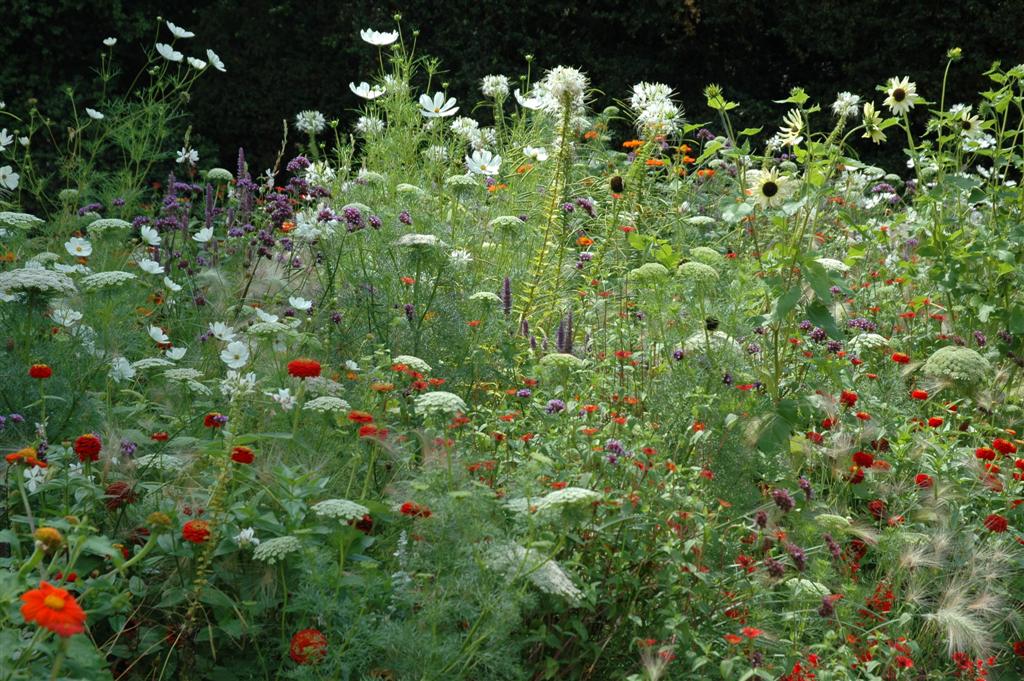
Close to the park entrance, one first encounters the annual beds. Although I didn't necessarily like all the plants used (I'm biased against certain annuals, such as amaranthus), it was an extremely interesting experiment which proves you can create a very intricate and rewarding planting tapestry based on annuals.


These 'summary' plant labels were posted in some areas, and I thought they really great. Rather than having to crawl around the beds to try to find a tag on each plant, here was everything together! Unfortunately, there were only a few of them around the park.

Past these beds begins one of the real show pieces of the garden, the North American perennial section. This is not a prairie inspired garden as there are mainly flowering perennials and only a few grasses (I'll have to save the real prairie sections for the next blog - I think Hermannshof is just too overwhelming for a single post). The first sections here were just bursting at the seams with the colour and exuberance of helianthus, rudbeckia and annual zinnia. Again, there was a handy summary label, though only some of the plants were listed.


We visited on August 8th (this was actually an earlier trip than the one to Peter Janke's garden.. it's all starting to blend together). Already a lot of dry seedheads, such as echinops, were playing a big role.


There were also some more subtle colour combinations in places, which were certainly not any less striking. Something to learn from each creation in this place.


Next time - the prairie inspired gardens at Hermannshof! Hopefully coming sooner than one month from now.