Showing posts with label prairie. Show all posts

Monday, March 25, 2013

The Toronto Botanical Gardens: Piet Oudolf's Entry Garden Walk

Piet Oudolf has done many high profile projects all over the world, but one that you may not have heard much about is the Toronto Botanical Garden.  That’s not really surprising since it’s a tiny project for Oudolf.  But for me, it’s a garden close to my former Toronto home and therefore close to my heart, and I have greatly enjoyed following its development since Oudolf was first commissioned for the job around 2005. In collaboration with local firm Martin Wade Landscape Architects, he managed to transform an utterly nondescript piece of land (I can’t even remember what it looked like before), to a fresh and complex garden.

The Piet Oudolf Entry Garden Walk at the Toronto Botanical Gardens, in January 2013.
First, I should explain something about the Toronto Botanical Garden, or TBG. You see, it’s not yet what you might think of as a botanical garden.  To date, the physical gardens cover only a few acres, and are actually only the entry gardens from the parking lot to the TBG building.  The TBG grew out of the Civic Garden Center, which was where the gardening community of north Toronto got together and hosted flower shows, garden club meetings and friendly educational events.  One day, an enthusiastic committee decided that it was time to get more serious and launched the Toronto Botanical Garden initiative.  They campaigned and raised funds, renovated the building, established a strong educational programme, and commissioned the entrance garden.  But the entrance garden is only a small start.  The TBG also sits at the head of Edward Gardens, a large former estate park that follows one of Toronto’s many creeks south through the city.  There is a lot of land available here, and if the TBG is ever to become a true botanical garden, this is the place it will have to grow into. But for now, we have an entrance garden, a Piet Oudolf one nonetheless!  


The garden showing its full glory in early fall 2012.
Martin Wade Landscape Architects were the main drivers of this project, and were responsible for the general layout and several of the individual gardens.  Oudolf’s contribution was the Entry Garden Walk, a long narrow walkway squished between the parking lot, the road, and the main building.  This garden consists of two fairly wide borders that flank a long straight path, with some small lateral shifts worked in for interest. Oudolf really had his work cut out for him in trying to achieve a satisfying and complex garden in this very exposed and narrow space. The plantings are done in his typical flowing prairie style, as one might expect, and were designed around the same time as the Lurie Garden in Chicago and Battery Park in New York.  

 
The narrow borders of the Entry Garden Walk.
The plant palette is recognizably Oudolf and suits the site and climate very well. It’s an open sunny site, and Toronto has hot dry summers and cold snowy winters.   Grasses like Deschampsia cespitosa (Tufted hair grass), several varieties of Panicum and Pennisetum,  and perennials like Echinacea (both white and dark wine colours), Perovskia (Russian sage),  Knautia macedonica, different lobelias, salvias, asters and many others are right at home here.  Although small, it’s a garden I have learned so much from.  Every time I visit, I notice a new and wonderful plant, which I must immediately add to my parents’ garden.  Some pleasant discoveries have included Calamintha nepeta ssp. nepeta,  which requires absolutely no care and always looks great, and Limonium latifolium (Sea lavender), with gorgeous, delicate sprays of flowers over much of summer.  But although I have used many of his plant selections as inspiration, I have not been able to copy Oudolf’s incredible sense of design.  Proof of this is that every time I go to the TBG with my parents, they stop to admire all sorts of plants and ask if we can’t add them to the garden. When I have to tell them they’re already there, I realize they just haven’t noticed them because they don’t look as good.  They might be growing as well, but they just don’t shine in the same way.

The garden in summer (early August), fall (early October) and winter (early January).

The Oudolf garden at the TBG has evolved a lot over time. Unfortunately I haven’t been able to find older pictures to show the garden soon after installation, and all the pictures here are from 2012, six years after the garden was planted. You’ll just have to take my word for it that the composition has become much more intertwined and complex as the years have gone by.  Reading the TBG website, I have also learned that the maintenance of the garden included absolutely no deadheading for the first 3 years in order to allow plants to self-seed and form a “sophisticated meadow”.  Now the plants are selectively deadheaded or weeded.

 
The evolving sophistication of the garden.  Plants are interweaving on all possible planes.
Oudolf has also added some unexpected elements to his design, in partnership with Martin Wade. For example, against one glass wall there are three espaliered crabapples, Malus ‘Donald Wyman’, which are planted at an angle.  While this may be a common technique in Europe, it’s not something often seen on this side of the pond, and for a long time the TBG got a flood of comments about when the trees would finally be straightened out. 
 
The angled Malus trees planted against an etched glass fence are most noticeable in the winter.  In the summer, they form one layer of greenery together with the rich underplantings and a row of paperbark maples, Acer griseum.

At the entrance to the building, there are also several boldly shaped hedges of mixed Fagus sylvatica (European beech), Fagus sylvatica forma purpurea (Purple beech) and Cornas mas (Cornelian cherry) grown within large metal frames. A very neat concept, which immediately added structure to the entrance area before the hedges were grown.

Decideous hedges grown within wire frames make a dramatic entrance to the TBG building in all seasons.
Well, that is just Oudolf’s part of the garden, and it’s taken me a lot longer to describe than I thought for such a small garden.  I’ll get to the rest of the TBG entrance gardens in the next blog – although small, they are home to some bold new design approaches and interesting plantings. 

Thursday, August 11, 2011

Hermannshof, Germany - Part II

Hermannshof is a fantastic, public experimental garden hidden in the small town of Weinheim in south-west Germany. The aim of Hermannshof is to showcase “successful examples of new directions in planting design, especially in the naturalistic planting style”. There is too much interesting stuff happening in this garden for just one blog, so this is part two. Last time I tried to give a little tour of the North American perennial garden, which uses many of the very striking flowering perennials we've come to know and love through the New Perennial movement. Although the North American perennial garden is open and uses a mix of both perennials and grasses, it’s a perennial flower garden rather than a prairie inspired garden. The separate prairie inspired gardens are the topic of this post.


The prairie gardens are found at the entrance section to Hermannshof, and are based on the tall and mixed grass prairies of North America. But signs are quick to point out that the gardens are not meant as a re-creation of a prairie, but rather an artistic interpretation of the prairie idea, which seems to so captivate European gardeners.


I found it very interesting to contrast these gardens with the previous North American perennial sections. Grasses make up the bulk of the planting, with flowering plants mixed in but at a pretty low percentage. The colour is predominantly green in early August, though it would be very interesting to see it later in the year as grass seed heads and fall colours become more apparent.


The planting seemed extremely informal and relaxed, but I think that belies its complexity. Flowering perennials were mixed in with layers of grasses in intricate ways. In some instances, there were large colonies of certain flowers, such as Echinacea angustifolia below. In other cases, many different single plants could be found in a small area. I wonder how much of this is controlled and how much is self-seeded, and what they do for maintenance in this garden.


In early August, the height of the plants was already impressive. Walking down some paths, you felt completely swallowed by the vegetation. The best 'garden' experience in my mind.


Although the North American prairie garden did get top billing, there were also two sections devoted to its European cousin, the Mediterranean steppe. I particularly liked one of them, which was used as a lead-in to the woodland sections. Shorter grasses dominated the scenery, and I especially admired the fluffy, soft seedheads of the grass below. Anyone know what it might be? Autumn moor grass (Sesleria autumnalis) also looked great, with very clean, bright green foliage. It was the perfect partner to lime green Peucedanum verticellare, which I didn't know before but it was used to great effect throughout this area.


Autumn moor grass (Sesleria autumnalis) in the foreground and the umbellifer Peucedanum verticellare (or Angelica verticillaris)

The prairie and steppe sections at Hermanshof are some of the most complex and interesting gardens I have seen so far, and I think it’s especially impressive to find them in a public park. It’s quite bold to use so few flowering plants in a public garden in a very non-traditional design. But there were a lot of people walking around who really seemed to enjoy themselves and pay close attention. Perhaps a small example that people will respond to many kinds of gardens.


I'm afraid there will have to be a part three for Hermannshof – it's getting late and I just haven't had the time to go through all the woodland pictures yet. And I have to pack for a trip home to Canada! Hurray!

Monday, August 1, 2011

Hermannshof, Germany

Of all the gardens showcasing the exciting horticultural developments now happening in Germany, Hermannshof is probably the best. It was at the top of my garden visiting list for a while before I finally made it there last summer. Hermannshof combines everything that is great in German garden design. First, it is a public park and free for anyone to stumble into. Second, everything in the garden is an experiment, and thus always changing, exploring and pushing boundaries. You can see almost everything in this garden because noses are not turned up at any plant family – there are outrageously flashy annual beds side by side with decidedly understated and un-garden like meadows.


The declared aim of Hermannshof is to study and showcase the modern use of plants. The park is a playground for garden director Cassian Schmidt and head gardener Till Hofmann along with 7 garden staff. And they are playing with a lot of different things – woodland plants, annuals, water plants. But clearly their passion, if one is to judge by what covers the most ground, are prairies and meadows in their many incarnations.


The garden itself is not very large, about 2.2 ha (5.5 acres) in total. There is a densely planted area at the entrance, where several beds are separated by paths and buildings. From there opens the main area of the park, which is roughly square with a circular path around the outside. The plantings are arranged around this circular path, while the center is simply lawn, though it was my impression that the plants were slowly encroaching. The planting style changes rapidly as you move through the garden to showcase various styles or habitats.

A much better map can be found on the garden website here.

Close to the park entrance, one first encounters the annual beds. Although I didn't necessarily like all the plants used (I'm biased against certain annuals, such as amaranthus), it was an extremely interesting experiment which proves you can create a very intricate and rewarding planting tapestry based on annuals.


These 'summary' plant labels were posted in some areas, and I thought they really great. Rather than having to crawl around the beds to try to find a tag on each plant, here was everything together! Unfortunately, there were only a few of them around the park.

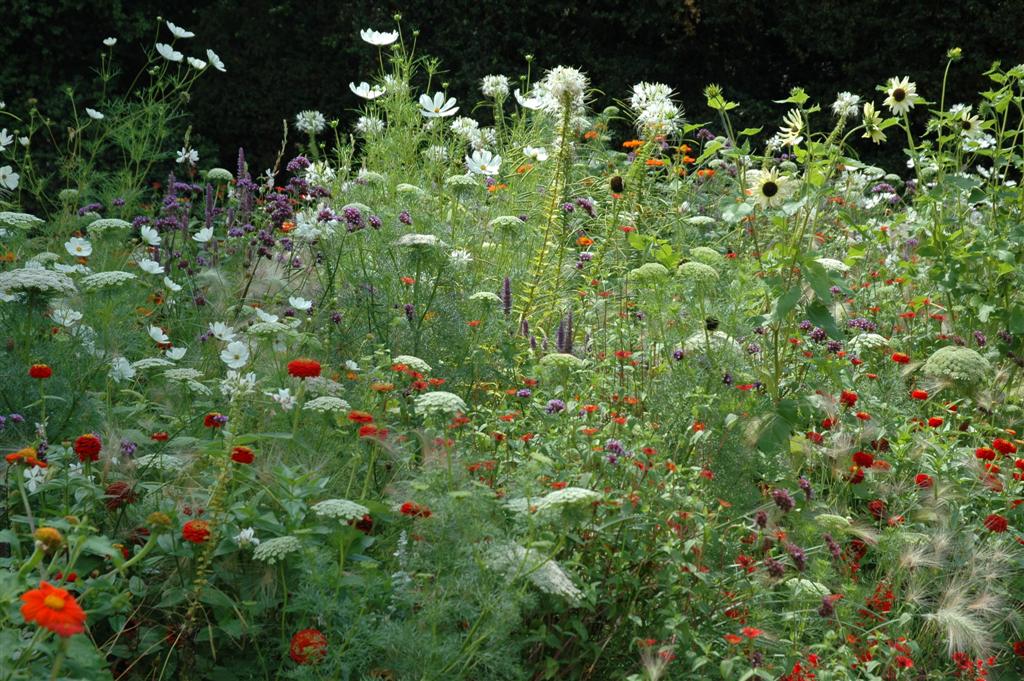
Past these beds begins one of the real show pieces of the garden, the North American perennial section. This is not a prairie inspired garden as there are mainly flowering perennials and only a few grasses (I'll have to save the real prairie sections for the next blog - I think Hermannshof is just too overwhelming for a single post). The first sections here were just bursting at the seams with the colour and exuberance of helianthus, rudbeckia and annual zinnia. Again, there was a handy summary label, though only some of the plants were listed.


We visited on August 8th (this was actually an earlier trip than the one to Peter Janke's garden.. it's all starting to blend together). Already a lot of dry seedheads, such as echinops, were playing a big role.


There were also some more subtle colour combinations in places, which were certainly not any less striking. Something to learn from each creation in this place.


Next time - the prairie inspired gardens at Hermannshof! Hopefully coming sooner than one month from now.