Showing posts with label grasses. Show all posts

Sunday, November 13, 2011

Karl Foerster Garden, Germany

The name Karl Foerster is enough to inspire awe in many gardeners, particularly those of us interested in perennial plantings and naturalistic design. Foerster first made a name for himself as a plantsman based on his innovative plant selections at his nursery in eastern Germany. Starting all the way back in 1903, Foerster looked at plants in a different way than most people. He wanted perennials that were sturdy and looked good massed, and was drawn to plants with elegant but strong flower spikes. His earliest work was with delphinium (a rather un-slender flower spike), but grasses soon became a favourite. Today, few gardens are without Calamagrostis x acutiflora 'Karl Foerster'.

The grass aisles at the Foerster nursery - uhhhhh.

In addition to plant selection, Foerster also dabbled in garden design. In the garden adjacent to his nursery, he experimented with a naturalistic planting style by combining grasses and massed perennials to achieve an overall meadow effect - an approach starting to sound almost too familiar today. His work is credited with greatly influencing the New German style of planting and the naturalistic planting movements that have since followed.


Clearly there is a lot of history at the Karl Foerster garden, so my expectations ran high. But as usually happens in these cases, the image built up in my mind did not exactly match the reality on the ground. The first surprise was the size. This is a small private garden created around the front and back of the family house. So expect a short visit to a tiny garden!


The second surprise was the content of the garden itself. I, unfairly, expected a very modern garden, one that would have been eons ahead of its time in the early 1900’s. But today the garden doesn’t look revolutionary to us, it just looks like something we’ve seen before. The plants are now familiar, and the style is hardly radical. It’s difficult to imagine how people viewed this garden during Foerster’s time, when annual bedding schemes and roses were the norm. It’s also hard to know how much the garden itself has changed over the years, as its maintenance has passed through several generations (currently Foerster's granddaughter).


Viewed with today’s eyes, this looks like a richly planted garden with an interesting mix of perennials, grasses and large trees, built around a fairly classical framework. In the back of the house is the rock garden, with mounded rocky beds and winding paths. There were many interesting examples of grasses here, such as the soft Carex alba planted between rocks. This garden is now quite shaded by large trees, conditions which seem less than ideal for some of the grasses.

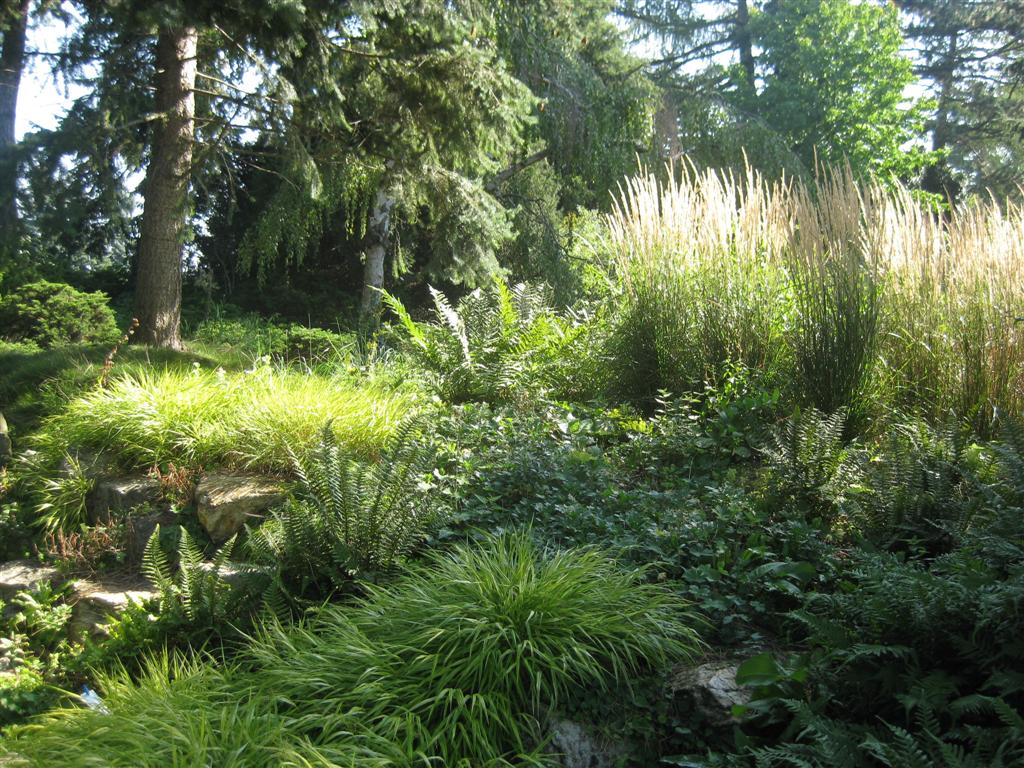

Carex alba and bergenia softening rocks.

The front garden is definitely the highlight of the visit. It’s a symmetrical garden built around a rectangular, sunken pond. It reminded me a bit of the water garden at Castillon-Plantbessin, one of my absolute favourite places. This one is almost just as good, which means I’m now officially in love with sunken pond gardens. The plants were tightly packed, and included a lot of the perennials and grasses we are now used to seeing. Overall, it seemed like a nicely designed perennial garden, but I didn’t get the sense that the style was ‘naturalistic’. Many perennials fit the naturalistic palette, but there were relatively few grasses and massed plantings. Regardless, it’s a little jewel of a garden which makes for an inspiring visit if you don’t bring along too many preconceived ideas.

Thursday, August 11, 2011

Hermannshof, Germany - Part II

Hermannshof is a fantastic, public experimental garden hidden in the small town of Weinheim in south-west Germany. The aim of Hermannshof is to showcase “successful examples of new directions in planting design, especially in the naturalistic planting style”. There is too much interesting stuff happening in this garden for just one blog, so this is part two. Last time I tried to give a little tour of the North American perennial garden, which uses many of the very striking flowering perennials we've come to know and love through the New Perennial movement. Although the North American perennial garden is open and uses a mix of both perennials and grasses, it’s a perennial flower garden rather than a prairie inspired garden. The separate prairie inspired gardens are the topic of this post.


The prairie gardens are found at the entrance section to Hermannshof, and are based on the tall and mixed grass prairies of North America. But signs are quick to point out that the gardens are not meant as a re-creation of a prairie, but rather an artistic interpretation of the prairie idea, which seems to so captivate European gardeners.


I found it very interesting to contrast these gardens with the previous North American perennial sections. Grasses make up the bulk of the planting, with flowering plants mixed in but at a pretty low percentage. The colour is predominantly green in early August, though it would be very interesting to see it later in the year as grass seed heads and fall colours become more apparent.


The planting seemed extremely informal and relaxed, but I think that belies its complexity. Flowering perennials were mixed in with layers of grasses in intricate ways. In some instances, there were large colonies of certain flowers, such as Echinacea angustifolia below. In other cases, many different single plants could be found in a small area. I wonder how much of this is controlled and how much is self-seeded, and what they do for maintenance in this garden.


In early August, the height of the plants was already impressive. Walking down some paths, you felt completely swallowed by the vegetation. The best 'garden' experience in my mind.


Although the North American prairie garden did get top billing, there were also two sections devoted to its European cousin, the Mediterranean steppe. I particularly liked one of them, which was used as a lead-in to the woodland sections. Shorter grasses dominated the scenery, and I especially admired the fluffy, soft seedheads of the grass below. Anyone know what it might be? Autumn moor grass (Sesleria autumnalis) also looked great, with very clean, bright green foliage. It was the perfect partner to lime green Peucedanum verticellare, which I didn't know before but it was used to great effect throughout this area.


Autumn moor grass (Sesleria autumnalis) in the foreground and the umbellifer Peucedanum verticellare (or Angelica verticillaris)

The prairie and steppe sections at Hermanshof are some of the most complex and interesting gardens I have seen so far, and I think it’s especially impressive to find them in a public park. It’s quite bold to use so few flowering plants in a public garden in a very non-traditional design. But there were a lot of people walking around who really seemed to enjoy themselves and pay close attention. Perhaps a small example that people will respond to many kinds of gardens.


I'm afraid there will have to be a part three for Hermannshof – it's getting late and I just haven't had the time to go through all the woodland pictures yet. And I have to pack for a trip home to Canada! Hurray!