Showing posts with label naturalistic planting. Show all posts

Sunday, November 13, 2011

Karl Foerster Garden, Germany

The name Karl Foerster is enough to inspire awe in many gardeners, particularly those of us interested in perennial plantings and naturalistic design. Foerster first made a name for himself as a plantsman based on his innovative plant selections at his nursery in eastern Germany. Starting all the way back in 1903, Foerster looked at plants in a different way than most people. He wanted perennials that were sturdy and looked good massed, and was drawn to plants with elegant but strong flower spikes. His earliest work was with delphinium (a rather un-slender flower spike), but grasses soon became a favourite. Today, few gardens are without Calamagrostis x acutiflora 'Karl Foerster'.

The grass aisles at the Foerster nursery - uhhhhh.

In addition to plant selection, Foerster also dabbled in garden design. In the garden adjacent to his nursery, he experimented with a naturalistic planting style by combining grasses and massed perennials to achieve an overall meadow effect - an approach starting to sound almost too familiar today. His work is credited with greatly influencing the New German style of planting and the naturalistic planting movements that have since followed.


Clearly there is a lot of history at the Karl Foerster garden, so my expectations ran high. But as usually happens in these cases, the image built up in my mind did not exactly match the reality on the ground. The first surprise was the size. This is a small private garden created around the front and back of the family house. So expect a short visit to a tiny garden!


The second surprise was the content of the garden itself. I, unfairly, expected a very modern garden, one that would have been eons ahead of its time in the early 1900’s. But today the garden doesn’t look revolutionary to us, it just looks like something we’ve seen before. The plants are now familiar, and the style is hardly radical. It’s difficult to imagine how people viewed this garden during Foerster’s time, when annual bedding schemes and roses were the norm. It’s also hard to know how much the garden itself has changed over the years, as its maintenance has passed through several generations (currently Foerster's granddaughter).


Viewed with today’s eyes, this looks like a richly planted garden with an interesting mix of perennials, grasses and large trees, built around a fairly classical framework. In the back of the house is the rock garden, with mounded rocky beds and winding paths. There were many interesting examples of grasses here, such as the soft Carex alba planted between rocks. This garden is now quite shaded by large trees, conditions which seem less than ideal for some of the grasses.

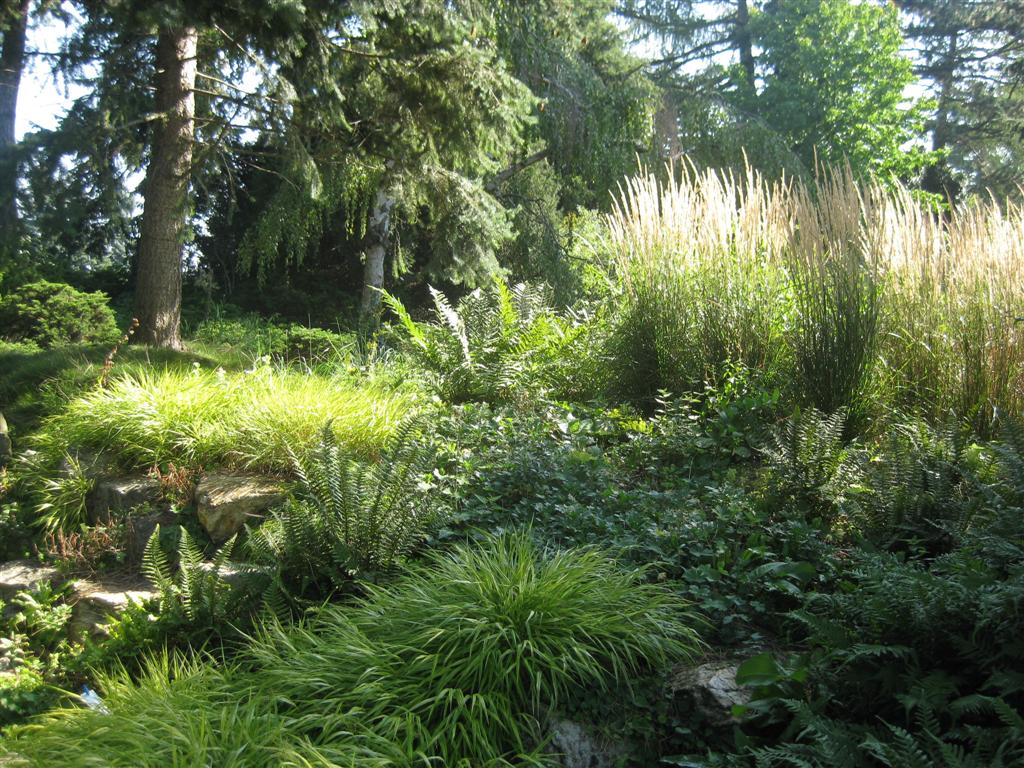

Carex alba and bergenia softening rocks.

The front garden is definitely the highlight of the visit. It’s a symmetrical garden built around a rectangular, sunken pond. It reminded me a bit of the water garden at Castillon-Plantbessin, one of my absolute favourite places. This one is almost just as good, which means I’m now officially in love with sunken pond gardens. The plants were tightly packed, and included a lot of the perennials and grasses we are now used to seeing. Overall, it seemed like a nicely designed perennial garden, but I didn’t get the sense that the style was ‘naturalistic’. Many perennials fit the naturalistic palette, but there were relatively few grasses and massed plantings. Regardless, it’s a little jewel of a garden which makes for an inspiring visit if you don’t bring along too many preconceived ideas.

Tuesday, August 3, 2010

Holbrook Garden, Devon, England

It's been a while – I can't believe my last blog was almost a month ago. Summer always seems to make time fly by even faster than usual, especially for gardeners. Although I can’t count myself in that category right now due the lack of a real garden, I’ve still been busier than usual visiting gardens. There have been some really good ones, so I’m excited to get back to the blog and take stock.

The first garden trip of the year was to England at the end of May, and included some highlights I have already posted about, such as the 2010 Chelsea Flower Show and The Lost Gardens of Heligan in Cornwall. The main part of the trip was spent in Devon though, where the first garden on the agenda was Holbrook. As one of the few new perennial gardens in the Devon area, and actually all of England, I clearly couldn't miss this one, especially when it's recommended by Noel Kingsbury as “one of the best examples of ‘New Perennial’ planting in Britain”.

Holbrook is a rather small, private garden with a nursery attached. It tries to pack in a lot of habitats, betraying a bit of the English plant collector spirit. There are dry, wet, and damp meadows, woodland edge, a pond, veggies and some chickens. The garden philosophy is firmly rooted in naturalistic ideas, with plantings designed to evoke natural plant communities. The owner’s inspiration comes from German naturalistic gardens, but I was also reminded of Dutchman Henk Gerritsen's garden – similar to his Priona garden, this garden also feels really relaxed and at peace with nature, although the design approach is quite different.


The first area close to the house is an open, dry prairie-style stone garden where the owners are experimenting with hot climate plants in strong colours. One unfortunate disadvantage of our visit was the timing – late May is not the peak of this garden area. It’s designed for fireworks in late summer. There were still some nice plants in bloom though, and some grasses were already making an impact. This area was quite small for a meadow planting, so I would have been interested to see how well it works at its peak. There are some beautiful pictures on the website to suggest it does succeed quite spectacularly.


Further down, the stone garden transitions to the wildflower meadow and woodland. Transition areas where you move from open sunlight to shade and enclosure often create some of the best effects in a garden.


On to the woodland area, which I thought was the most successful in the garden, though this may have been biased by the timing of our visit (although most early flowering wildflowers and shrubs were past). The relaxed and comfortable feel in this garden area fit perfectly with the domesticated English countryside where Holbrook is located - soft, un-cut grass, dotted by small woodland edge trees letting through filtered sunlight, larger oaks in the background, and a small stream on the boundary. Perhaps this may not be as exciting to the owners as some more innovative prairie and dry plantings, but as a visitor this felt like the most comfortable planting.


The pond with the surrounding marshy plantings took up the center of the garden, and like the woodland, fit very comfortably in its site. The wet meadow surrounding it was much further along than the prairie garden, although the full peak of this area is probably also right about now.


Overall, this garden had a lovely feel to it, and some nice naturalistic plantings. I do wish I would have seen the full climax of the meadow plantings, to better learn from the planting style and to see exactly how well they work in a small space divided in so many habitats.