Thursday, April 21, 2011

Monet's Garden, Giverny, France

I once read that artists who sketch or paint in public often find that people who glance over their shoulder spend more time looking at the subject than the work of the artist. It seems that we are first interested in what inspires the artistic eye, and only afterwards by the results of that inspiration. Maybe that’s what the long line of visitors outside Monet’s Giverny garden hope to get – a glimpse over the master’s shoulder at the source of his inspiration.


Monet’s garden is one that most of us already feel some sense of familiarity with, thanks to his many paintings of it. In real life, it’s almost exactly as I imagined it to be. The first section close to the house is a very domestic, traditional flower garden, divided into simple rectangular beds devoted to flowers. Monet spent a lot of time devising colour and plant combinations, and fortunately left behind a lot of material – notes, photographs (mainly by visitors), and of course paintings – that can be used to plan and maintain today’s gardens. And even though ‘traditional’ comes to mind when describing this area, the design and plantings are certainly unique – even a small corner photographed can instantly be recognized as Monet’s garden. The house itself is also really lovely by the way, and features his large painting studio, a cozy kitchen and yellow dining room, and a huge collection of Japanese prints that fill every square inch of wall.


But across the road (now reached through an underground tunnel), is the magical spot everyone is most keen to see – the lily pond. And yes, it is just as magical and inspiring as one could hope. It’s an enclosed garden, completely surrounded by an envelope of tall trees. It’s hard to tell exactly where Monet’s paintings of it, lodged somewhere in our subconscious, stop and where reality begins. The light shimmers off the water and willows, the colours blend into each other, and everywhere you turn you can imagine a perfect little tableau. We have a ridiculous number of photographs from this garden because almost every angle seemed perfect.


Monet described his two main occupations as painting and gardening, and it’s hard to tell which came first. He started gardening when young and said that flowers inspired him to become a painter. As an adult, he created gardens at all the properties he rented, but most extensively at Giverny because he was able to buy it. He used his gardens as subjects for paintings, and used his paintings to learn which compositions and colour combinations work best. In the end, he declared the garden as “his most beautiful work of art”, a gratifying thing for us gardeners.

Tuesday, April 5, 2011

"Where is the garden?"

A few weeks ago (actually, I now realize that it was a few months ago... ), I was reading Thomas Rainer's series of posts on his blog Grounded Design on the use of native plants, and the related story of the native gardens at New York Botanical Gardens. It seems that the NYBG is currently transforming these areas because they failed to impress visitors. The originals were designed to illustrate various native habitats, but their small size made them difficult to maintain, and in the end the “general public was left wondering exactly where the ‘garden’ was”. In response, the gardens are now being transformed into new designed landscapes with bolder plants and a more refined design, which should hopefully prove more popular. Rainer goes on to say that if native plants are to be successfully adopted into mainstream gardening, they must meet our criteria for “ornamentally beautiful” plants, meaning that they should be “pretty” and “showy”. The public isn’t going to fall for a patch of rough grass with a handful of hidden orchids. Also, we should be using these plants in “designed landscapes”, rather than confining them to designs that usually try to mimic some natural habitat. And that got me thinking… are we just trying to change the varieties of plants we use, or are we trying to change the types of gardens we create?

First, I should say that I fully understand the problem Rainer describes. Maybe it’s fair to say that the average person enjoys bright colours and “knock-your-socks-off bloomy” borders much more than something they could encounter on the side of the road. We are attracted to flowers and colours, so perhaps we should just acknowledge this as a universal starting principle in all design. I also agree that just because we’re trying to use more native plants doesn’t mean we should always try to mimic a certain habitat.

But at the same time, I can’t help feeling that there should be more to this than just trying to find sufficiently dramatic native plants. We seem to be on a bit of a movement for more ecologically sensitive gardening. Maybe this movement could be about more than just exchanging one colourful plant for another; maybe we can change our whole perception of what a garden is?

This brings to mind two rather well known garden makers: Piet Oudolf, the internationally recognized guru, and Henk Gerritsen, the lesser-known wild child. Oudolf has become a huge influence in the landscaping world by using new plants in new ways. He has helped change our perceptions of gardens, and I, like so many others, admire and enjoy Oudolf’s work a lot. At the same time, I would argue that he is still playing by the rules of the game. People don’t wonder if Oudolf’s gardens are gardens – they clearly are, but they are new and different. His strength is that he has found a balance between managing our desires for an aesthetically organized and fairly colourful and ‘showy’ garden, while still pushing the envelope.


Henk Gerritsen was a colleague of Oudolf’s, and they collaborated and shared ideas on many new concepts. However, Gerritsen’s garden ideas were far more wild and pushed the concept of a garden further than Oudolf. I’m by no means an expert on his philosophy (especially as I haven’t even read his book -can’t find a reasonably priced copy anywhere!), but I have been to his garden. When I was there, my first impression was that it was a bit too disorganized and unkempt in parts, perhaps losing the feeling of a garden. But it had the most incredible atmosphere, and almost 2 years later it’s still one of the places I think back to the most. Flowers were far fewer and smaller, plants seeded everywhere, and the buzz of insects was deafening. It was wild and overwhelming at times, but also gentle and comforting at others. Gerritsen’s approach is far messier and less structured than Oudolf’s, and I’m sure many visitors to his garden have been left wondering ‘where the garden is’. But in the end, for me at least, this kind of ‘borderline’ garden provided a richer experience than many other gardens I have been to, one of being truly immersed in an outdoor, green space.


Human perceptions of beauty can change, often dramatically, over time. Gardens are no different. Although we’ve been trained for showy flowers and ‘designed landscapes’, we’ve already started to appreciate new types of gardens. Maybe we can push this even further, and come to appreciate all sorts of experiments as gardens - even those with – rumpled textures, subdued flowers and a little bit of chaos just beyond our control.

Wednesday, March 16, 2011

Images of spring

Since I'm now among the ranks of gardeners who can brag about all the lovely things that are already in bloom in March, I thought I would take advantage of it. Who knows when I'll find myself back in the harsh winters of Eastern Canada, complaining about all the show-offs in Britain or the West Coast. In that generous spirit, here are some pictures I took this weekend at our little botanical garden in Leuven (at least I can't brag with my own flowers since I'm living in an apartment, although I do have little Tête-à-tête daffodils blooming in outdoor containers). Even though it's only early March, flower colours ranged the full spectrum, from pure white hellebores to the dark burgundy blossoms of Parrotia persica.


Erythronium dens-canis 'Rose Queen'.

Parrotia persica.

And with spring we also welcomed several new lambs at our CSA farm. Only a few days old, they were running around as sure-footed as their parents.

Tuesday, February 22, 2011

Domaine de Villarceaux, Île-de-France

It seems that no trip to France is complete without a requisite castle visit. During our vacation in Normandy, we weren’t exactly seeking them out, having already overdosed the year before in the Loire Valley. Still, we couldn’t escape at least one, and that one ended up being Domaine de Villarceaux. The choice was quite random (I think we might have spotted it in a brochure), but it led us to a hidden treasure.


Domaine de Villarceaux is different from any other castle I’ve been to in France. First off, there are no hordes of tourists, probably because it only opened to the public fairly recently and it is almost impossible to find. Second, this particular chateau can only be visited by guided tour. With only 6 people on our tour, including our own group of 4, it was a treat to have a personal, expert tour leader. And third, the whole thing, including the guided tour, was free! This must be unique in all of France.

The highlight of Domaine de Villarceaux is definitely the gardens. The chateau itself is quite small, and not as impressive as some others in the area, though still certainly worth a visit. However, the gardens, which sweep from the castle down a hill and into a broad valley, are enough to fall in love with. The building blocks of the garden are classical and minimalist: lawn, hedges and water. What makes them remarkable is the way all the elements sit so well in the landscape, how they fill the space, and how easily they flow into one another.

The entrance to the chateau is on the far side of the property, by the stables and other utilitarian buildings which are quite beautiful in their own right.


The tour of the gardens proper starts up a few worn steps to a small stone tower, which was built especially to hide and protect the property’s spring, apparently a very valuable commodity in former times. Surrounding the tower is an enforcement wall and a surprising, elevated herb garden. Hidden by walls on all sides, and with no seeming connection to the ground, this garden felt a bit like a secret sorcerer’s laboratory.


Descending from the magical herb garden, you are met by the best view at Villarceaux: a floating garden backed by a long view of the valley. The floating garden is in fact an intricate hedge parterre, surrounded and transected by still, dark water on all sides. It’s the first time I’ve seen this and the effect was unmistakably ‘floating’ and very striking.


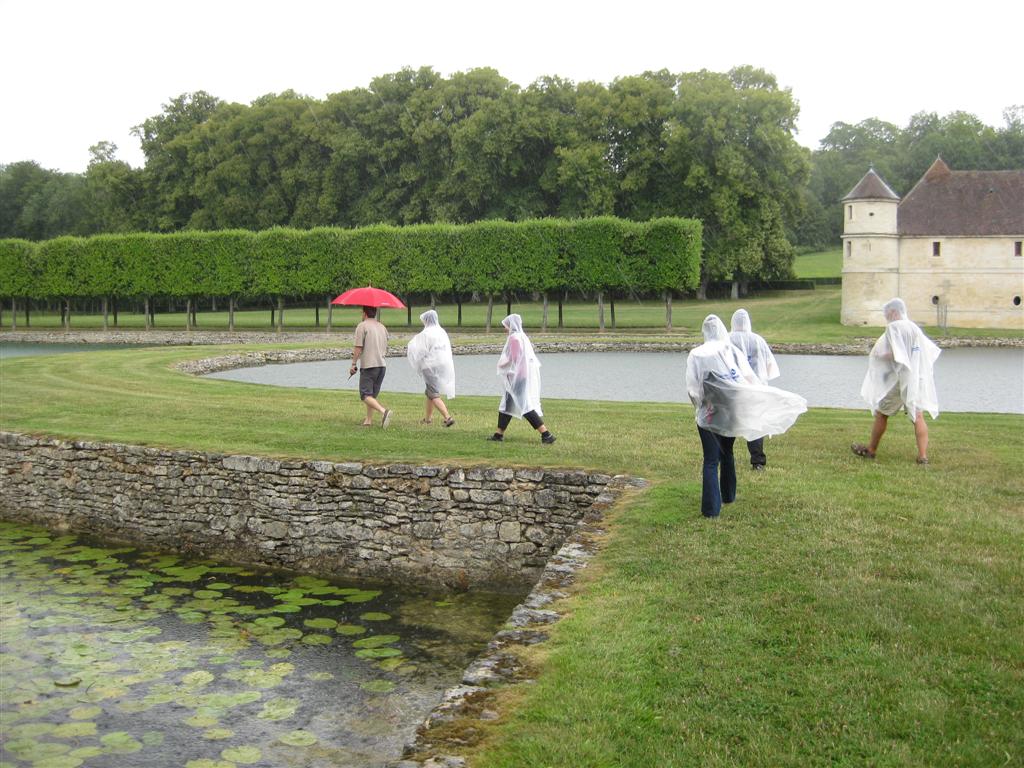
The gardens then proceed to snake their way through the valley, with a large grass bridge between two bodies of water leading up to the castle. On our visit, it started to rain at this point and the very friendly staff came running down with rain jackets for everyone (yet another unique feature at Villarceaux)!


The castle itself doesn’t make an appearance until the very end of the visit, after a fairly long climb up a grassy slope. The slope is intentionally designed to be nearly invisible from the castle thanks to clever land-shaping. This was done in order to make the outer landscape, including the lake at the bottom of the valley, appear much closer, right outside the castle doors. Only those who venture outside to explore the grounds are surprised by the long stroll down and the many secrets of the gardens below.


One last neat thing about Domaine de Villarceaux is their environmental conscience. The gardens are managed completely organically, and plans are underway to construct a tiny hydro plant in one of the ponds to supply power for the fountains and garden lighting.

Sunday, February 6, 2011

Les jardins d'Argences, Normandy, France

Les jardins d'Argences are residential gardens created around a beautiful stone mansion in Normandy. The house is stunning and the surrounding countryside even more so. But unfortunately, my honest impression of the garden was that, while nice enough, it was missing that special something. Everything is very pleasant and comfortable, but there are no moments when you feel captured by this garden. It’s the type of place you could easily relax in with a nice book and a glass of wine, but you’d be admiring the house and the tranquil French countryside first and foremost. And that doesn't sound too bad, except that in this case there are in fact gardens which occupy the space between house and countryside and that's what we went to visit.

Before I launch into this one, I just want to issue one warning: this garden is extremely photogenic. I look back at the pictures and I almost don’t recognize the place. It’s another example of how the camera can, and often does, lie. By always trying to take good pictures and choosing angles, we didn't capture the place honestly. You’ll have to trust me that something was missing in this garden though, because the pictures sure don’t give it away.

The gardens at Argences were created by the owner, Mme Caroline Lecardonnel starting in 1989, after purchasing the house. There is a heartfelt essay on the website where she describes the creation of the gardens, and her own aspirations as a gardener. This of course makes me feel very guilty saying that the gardens are only so-so, but in the end, the passion and reward the owner puts into and derives from her garden are not connected with a strangers’ impressions of it. Although in all honesty, everybody loves to hear that their creation appeals to others. A discussion for another day…

The owner’s first gardening attempts resulted in little skinny borders, which she was painfully dissatisfied with. That was all the motivation she needed to launch into the project full force , ending up with 9 different gardens scattered around the house at present. The best parts are actually the oldest, which perhaps don't try to do too much and work off the house, using its French charms to full advantage. The courtyard in the middle of the U-shaped main buildings is the best example. You don’t need much when you already have such a perfect setting – a few plants crawling up the stone house, some old shade trees and a generous patio of local stone (which is where I would sit with that book and drink) are more than enough.


From here, you go on to various small garden spaces surrounding the house. The first two are formal in nature, with a rectangular, shallow pond in the first, and a large parterre in the second.


The garden in the back of the house features more informal, English-style borders of perennials and a circular pond one one side of the central lawn. The pond is a perfect example which I think shows how the camera can distort one's perception. In the first photo, the angle makes the lawn look nicely anchored in the garden, a perfect garden picture. But from another angle, you can see that in reality it's floating on one side of the lawn, and meets up awkwardly with the straight-edged flower border.


To travel on, you follow a small stream in a little valley around the side of the house. This offers a very pleasant respite from the open areas, complete with lush stream-side plantings.

More gardens await at the end of the stream, including some with a more formal layout as well as a more casual garden composed mainly of lawn, with a few, not particularly happy-looking, perennials and a naturalistic pond in the middle. And there’s also the requisite labyrinth.


So, why didn’t I like the gardens? In my opinion, the incredible potential of a beautiful French house and property were wasted. I had the feeling that I was walking through a series of gardens I had seen in different books, placed here on the whim of the garden maker, but with no connection to each other. This is a beautiful spot that demands its own treatment, not just a collection of gardens to show off different styles. I thought the saddest example of a missed opportunity, of not looking at what is there, was the moat. Yes, the house had a moat on three sides; a centuries-old one with mossy stone and actual water flowing through it. And yet, it’s not in any of the pictures because the gardens completely ignore it, and in fact obscure it most of the time.

And then there were the details. I often forget how important they can be, but this garden was a good reminder. There were many little things that just felt a little off, enough to change your whole perception. In some cases the proportions didn't feel quite right, or there were walkways that didn’t connect or weren’t wide enough, or patches of glaringly bare soil between plants. These are the kind of things that don’t show up on camera, but play a huge role in shaping your impressions when you're there.


Thursday, January 13, 2011

Les Jardins de Castillon-Plantbessin, Part 2

Again and again, I find it so difficult to try describing what makes a garden great, never mind actually pin-pointing specific attributes. It’s not that I’m trying to categorize all gardens into good or bad, but when you walk into a beautiful garden, it’s instinctual to ask what makes it so. Of course there’s no formula for beauty, but there are ingredients. What I mean to say with that lengthy prologue is that Les Jardins de Castillon-Plantbessin is a great garden, but it’s difficult to describe what sets it apart from a merely good one.


The history of the gardens at Castillon is not too different from many others: husband and wife team (Colette and Hubert Sainte-Beuve) start nursery, become completely obsessed by it, and create superlative garden. The first garden at Castillon was created in 1985, conceived and implemented entirely by the owners. The second garden is a more recent addition and was designed with the help of artist François Houtin. The two gardens, old and new, are similar in size, two rectangles that approximately mirror each other on either side of a wide central path.


The plan that the owners started with for the first garden sounds like a sure recipe for disaster. The concept was a series of themed garden rooms covering almost all garden styles known to man, from the quintessential English double border to minimalist Zen. Sounds like a case of falling in love with plants and gardens, and wanting to have a little bit of everything. But even I know that this cannot possibly succeed – it’s a mish-mash, it muddles the message and it’s nearly impossible to create a coherent picture with a sense of place (although it's still possible to have many impossibly pretty vignettes).


Doesn’t sound too great up to now, does it? Well, that’s where the second garden comes in. This garden somehow manages to pull the whole thing together into one cohesive, memorable experience. I have a few theories (3 to be exact) as to why it works: it guides your journey, the design is in harmony with the older garden, and it has a clear focus which draws out the best qualities of the old garden and the place itself.

Journey
How you are led through a garden is so important – it guides your mind and defines how you experience the space. At Castillon, according to the prescribed visit plan, you start with the new garden and proceed through it entirely before crossing the central path over to the older section. Once in the older section, you start with the water garden first (which I gushed about previously), which is the most stunning garden in the original area, and the one that clearly links to the new garden. I suspect that the theme of this particular garden (water combined with a rich plant palette based mainly on greens and textures) served as the key inspiration for the new garden. So, after a great first half and a fantastic transition into the second half, by the time you get to the more so-so sections of the old garden, you are already so enchanted you hardly notice.

Layout
To keep the design consistent, the layout of the new garden also uses garden rooms. However, the divisions are very simple – the long rectangular space is divided into 3, square-ish rooms. Straightforward paths take you around each room, and a central opening is used to transition between spaces. I've recently read criticism about gardens designed as rooms, because the constant shifts don't allow for a single experience, a feeling to develop. I’m in the same camp, but I think it works here because the rooms don’t actually offer completely different experiences, just sequential illustrations of the same theme. The divisions could easily be taken down and a cohesive whole would result. Also, the ‘room’ concept was used here to link with the design of the older garden, and works well to achieve a unified overall picture.

Substance
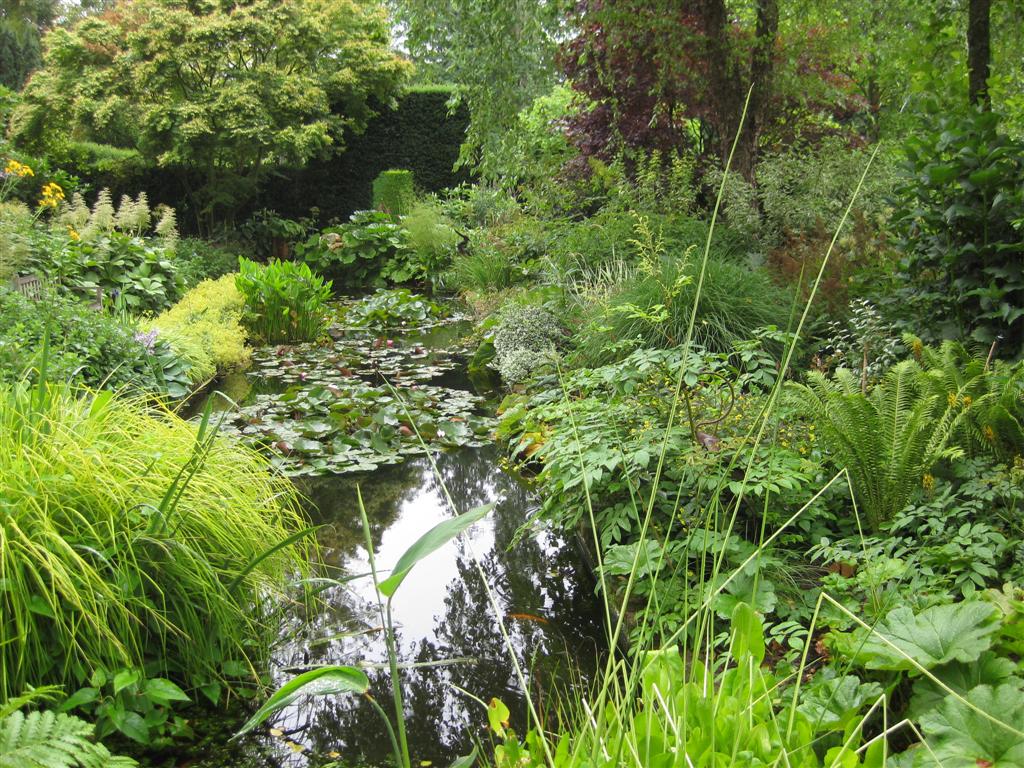
Lastly, we come to the actual content of the new garden, the best part. We visited on a rainy, gray morning in July. Water seemed to be everywhere – in the heavy, grey clouds above, trickling down our rain jackets, and glistening on every plant and path. Given the watery mood, which is more or less typical of Normandy, the many ponds and fountains in the gardens seemed like a perfect fit. The dark water and wet stone provided the needed contrast to the lush plantings – layers of textures and shades of green sparkling with water beads, and both water and the plant palette seemed to capture the general mood of the place.

Since that blurb was a bit all over the place, I saved the pictures for last to show the journey through the garden as experienced first-hand (captions below the pictures).


The central path where you enter the garden from the parking lot. The tall hedges on either side guard the secrets of the two gardens, new (right) and old (left).


The first space in the new garden is all foliage and structure, soft and strong at the same time. It beckons you downwards and onwards through the gardens.


The transition between the first and second garden room.


Water.


Stepping stones across the pond guide you onwards.

From water and lushness, to a more subdued, open lawn.

Labyrinth hedge.

After crossing the central path, you are plunged back into water and impossible lushness.

Phew - overdrive of senses somewhat relieved by more traditional borders and lawn of the old garden.

Castillon is a garden I keep thinking about, images of it popping up in my head randomly when I’m daydreaming.